
Natural Mosquito Repellents That Actually Work: Evidence-Based Guide
Only a handful of natural mosquito repellents have measurable scientific backing. Oil of lemon eucalyptus (OLE) and its synthetic version PMD are the most effective plant-based options, matching low- to mid-strength DEET for many conditions. Citronella, lemongrass, and other essential oils provide very short protection (under 20 minutes in lab tests) and frequently fail in real-world use. If you need reliable coverage for a hike, backyard barbecue, or camping trip, OLE-based products are the only natural choice that consistently works.
Quick Decision Aid
- [ ] Do you need at least 2 hours of continuous protection? If yes, skip citronella and other single-oil products — they will fail. Look for OLE or PMD.
- [ ] Is the mosquito pressure moderate to high (dawn/dusk, near standing water, tropical area)? Natural repellents won’t match high-concentration DEET, but OLE at 30% is effective for about 4–6 hours.
- [ ] Are you pregnant or nursing? OLE is considered safe by the CDC when used as directed, but check with your doctor. IR3535 (synthetic but derived from alanine) also has a good safety profile.
- [ ] Is your skin sensitive or prone to reactions? OLE and PMD can cause irritation on some people. Test a small area first, or choose products with lower concentrations (10–20%).
- [ ] Will you be sweating heavily or in rain? Water resistance varies. Some OLE sprays are labeled water-resistant for up to 2 hours; reapply sooner if you’re wet.

The Evidence-Backed Natural Repellents
Only three active ingredients have multiple controlled studies showing meaningful mosquito repellency. Two are plant-derived, and one is semi-synthetic with natural origins.
Natural here means plant-based or derived from a natural compound. The EPA classifies all of these as minimum-risk pesticides, but efficacy varies widely.
Oil of Lemon Eucalyptus (OLE) and PMD
OLE is extracted from the leaves of the lemon eucalyptus tree. PMD (p-methane-3,8-diol) is a synthetic version of the same compound. The CDC and EPA both list OLE as an effective mosquito repellent.
- Duration: 4–6 hours at 30% concentration (similar to 20% DEET). Lower concentrations (10–15%) last 1–2 hours.
- Coverage: Effective against Aedes, Anopheles, and Culex mosquitoes (the main disease vectors).
- Trade-off: OLE has a strong, medicinal lemon-camphor smell that some find unpleasant. It can cause stinging on broken skin.
IR3535
IR3535 is a synthetic compound modeled after a natural amino acid (alanine). It is not strictly plant-based, but it is often grouped with natural alternatives because of its biochemical origin. The CDC endorses it.
- Duration: 2–4 hours at 10–20% concentration.
- Coverage: Similar to OLE for most mosquitoes, but slightly weaker against Aedes aegypti.
- Trade-off: It is less greasy than OLE and has a mild scent. Some brands blend it with aloe for skin comfort.
Citronella
Citronella oil is the most widely marketed natural repellent, but the data is weak.
- Duration: Lab tests show complete protection for 20 minutes or less. Field studies often fail to show any difference from a placebo after 30 minutes.
- Coverage: Partial against some species, but unreliable.
- Trade-off: Candles, coils, and wristbands provide negligible skin protection. The only way to get marginal benefit is to apply high-concentration oil directly to skin and reapply every 30 minutes.
Other Essential Oils (Catnip, Peppermint, Lemongrass)
A few oils show moderate repellency in lab cages — catnip oil at high doses has matched DEET in some petri-dish trials. But field conditions are a different story. The concentration needed to repel mosquitoes on skin is often above what is safe for continuous use (catnip oil above 5–10% can cause skin irritation). Most commercial “natural” sprays contain less than 2% total essential oils, which evaporate or get rubbed off within minutes.

Practical takeaway: If you see a spray listing multiple essential oils but no single active above 5%, it will not provide meaningful protection beyond scent masking. You’re better off with a dedicated OLE product.
How to Choose the Right Natural Repellent for Your Situation
The decision hinges on three variables: duration needed, mosquito pressure, and skin tolerance.
Scenario 1: Short, low-risk outings under 1 hour with no biting pressure
Any product with OLE 10–15% or a well-formulated citronella spray works. You can reapply often, and the risk of being bitten is low.
Scenario 2: All-day hikes or evening events in moderate pressure
Use OLE 30% or a PMD-based spray. Reapply every 4 hours or after sweating. IR3535 at 20% is a close second if you dislike the OLE smell.
Scenario 3: High-pressure environments such as tropical zones or peak mosquito season
OLE 30% is your best natural option. Consider switching to a synthetic repellent (20–30% DEET or 20% picaridin) if you cannot afford a failure. Natural options still work but require vigilant reapplication.
Scenario 4: Sensitive skin or children under 3
IR3535 at 10–20% has a lower irritation risk. OLE at 15% is acceptable for children over 3 years old. Always patch test first. The CDC advises against OLE for children under 3.
How to Apply Natural Repellents Effectively
Even the best active ingredient fails if applied incorrectly. Here is a step-by-step flow with built-in checkpoints.
Preparation
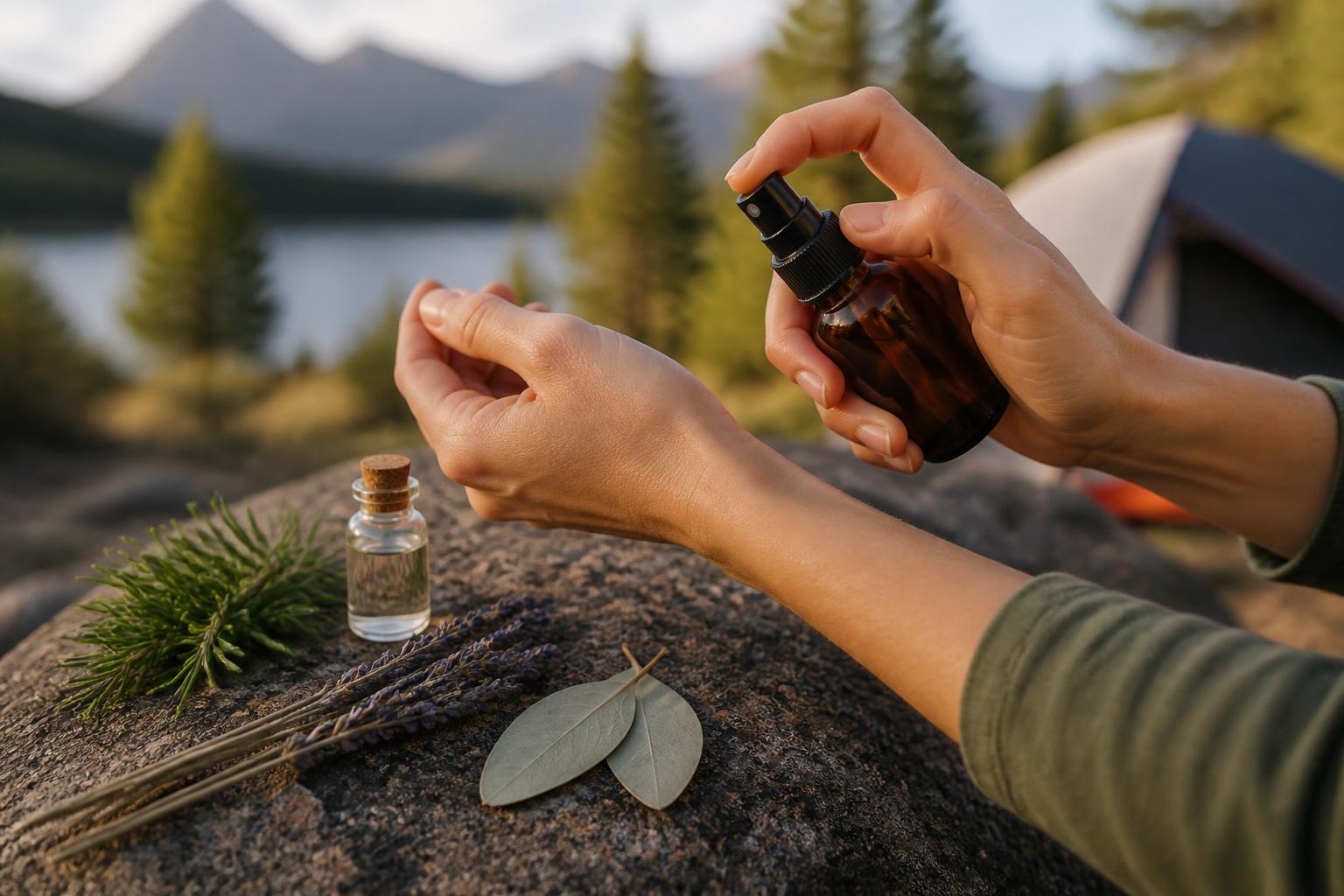
Shake the bottle vigorously — oil and water separate fast. Apply to all exposed skin in a thin, even layer. Do not spray directly onto your face. Spray into your hands, then rub on your face while avoiding eyes and mouth.
Ordered Application Steps
- Cover high-bite zones first: Ankles, tops of feet, back of neck, and wrists are most vulnerable. Apply a visible film, not a mist.
- Wait 30 seconds for the carrier to dry before putting on clothing or sunscreen over it.
- Do not rely on clothing alone — mosquitoes can bite through thin fabrics. Treat shirt collars and cuffs lightly with spray.
Early Checkpoint: The 15-Minute Bite Check
15 minutes after application, stop and inspect your ankles and forearms. If you see even one mosquito landing and biting, the repellent is failing. This can mean:
– The concentration is too low for the local mosquito species.
– You missed a patch of skin.
– The product has degraded (expired or stored in heat).
Likely Causes of Failure
- Insufficient coverage: People tend to apply a thin mist instead of a continuous film. Use enough product to cover skin visibly.
- Too low a concentration: Many natural sprays sold as citronella or lemongrass have active ingredient levels below 2%. They do not work.
- Scented body products: Lotions, perfumes, or sunscreen can interfere with the repellent layer and attract mosquitoes.
Success Check: Zero Bites After 30 Minutes
If after 30 minutes of outdoor exposure you have no bites while unprotected friends nearby do, the repellent is working. Record the time — that gives you a reliable reapplication interval.
When to Escalate to Synthetic Repellents
If after proper application of OLE 30% you still get multiple bites within 2 hours, the mosquito pressure in your area is too high for any natural product. Switch to a 20–30% DEET or 20% picaridin formula. This is not a failure — it is a realistic match of tool to environment. Stop trying natural options at this point; they will not outperform synthetics in high-pressure zones.
What Does Not Work and Why
- Ultrasonic devices and apps have no peer-reviewed evidence showing any mosquito-repelling effect.
- Wristbands with any active ingredient do not work because the vapor cloud from a tiny patch inside a band does not cover your arms, legs, or head. Lab tests show no reduction in bites.
- Garlic, vitamin B1, or brewer’s yeast have been tested in multiple controlled trials over decades with zero repellency found.
- Bug zappers kill mostly harmless insects and may actually attract mosquitoes to the area.
FAQ
Does oil of lemon eucalyptus work as well as DEET?
At 30% concentration, OLE provides comparable protection to 15–20% DEET for most mosquitoes. For high-pressure or disease-risk areas, high-concentration DEET at 30–50% still lasts longer and is more reliable.
Is oil of lemon eucalyptus safe for pregnant women?
The CDC considers OLE safe when used according to label directions. Many doctors advise applying it to clothing instead of skin during pregnancy. Consult your healthcare provider for personal guidance.
Can I make my own natural mosquito repellent from essential oils?
Homemade blends are not recommended because you cannot control concentration, stability, or skin safety. Commercial products are tested for efficacy and irritation risks. DIY recipes have no proven track record.
How often should I reapply a natural repellent?
Every 2–3 hours for OLE at 30%, or as directed on the label. Reapply immediately after swimming or heavy sweating.
Which natural repellent is best for children?
For children 3 years and older, OLE at 15–30% is acceptable. For younger children, use only bug netting or clothing as physical barriers, and talk to a pediatrician before using any repellent.

Camping Bob has spent over 20 years camping across the US — from BLM dispersed sites in the Southwest to KOA campgrounds in the Pacific Northwest. He writes practical, no-nonsense guides to help fellow campers get outdoors with confidence.