
Best Camping Pillows: Compressible, Inflatable & Hybrid Options
The right camping pillow depends less on the brand and more on how you sleep. Side sleepers need real loft to fill the gap between shoulder and head. Back sleepers can get away with a thin pad. Ultralight hikers should prioritize pack weight above everything else. The three main types—compressible, inflatable, and hybrid—each solve a different problem, and picking the wrong one means a sore neck at best and a ruined night of sleep at worst.
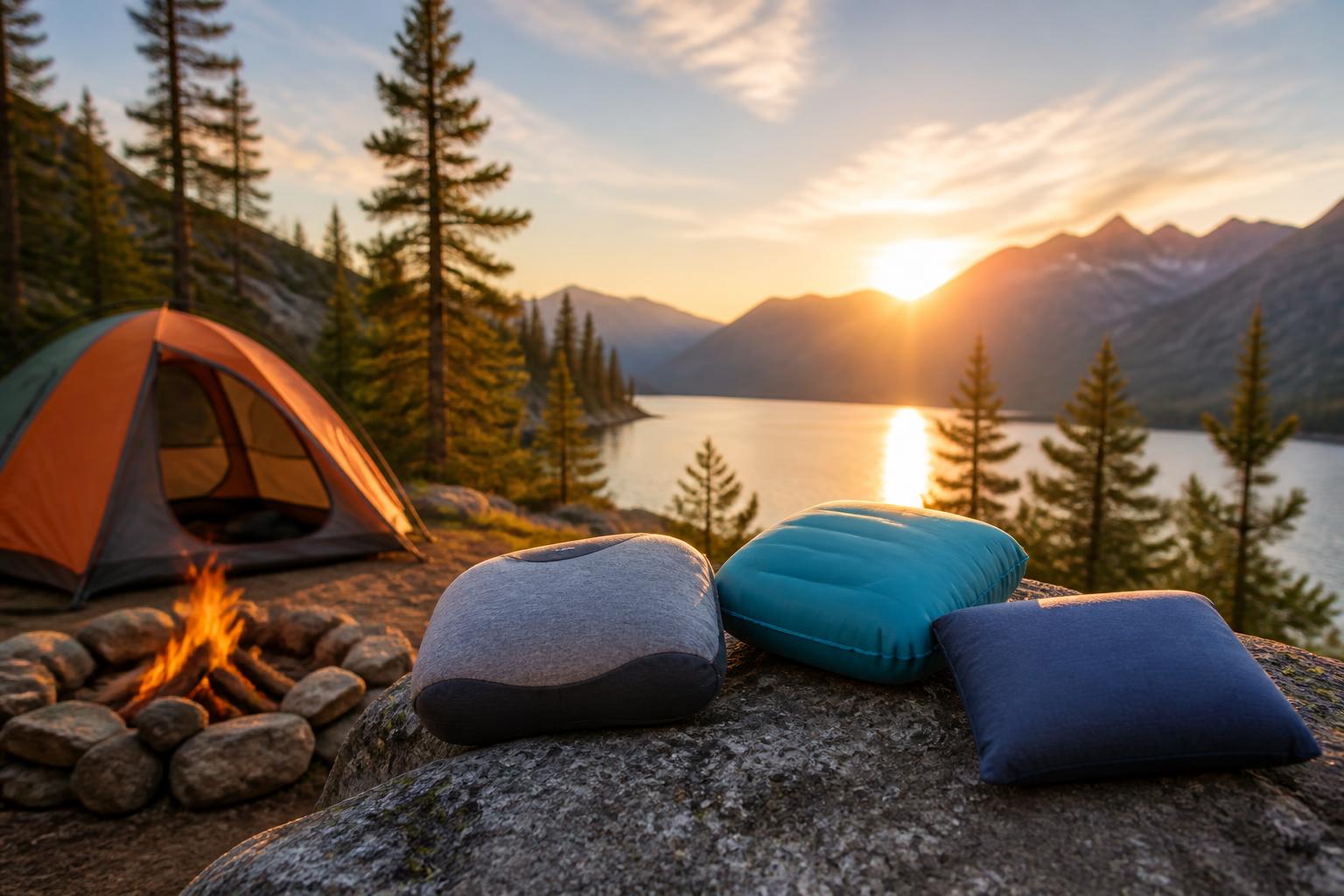
Quick answer
If you want maximum comfort for car camping or basecamp trips, buy a compressible down or synthetic pillow (Therm-a-Rest Compressible, Nemo Fillo, or similar). If pack weight is your top concern, an inflatable like the Sea to Summit Aeros Premium saves serious space and weighs under 3 oz. For a middle ground, hybrid pillows pair a thin foam layer with an air chamber—good for backpackers who want more comfort than a bare air pillow provides.
Your sleeping position overrides every other factor. A 2-oz inflatable works fine for a back sleeper but will leave a side sleeper waking up every hour to reposition. Shop by your position first, then by trip type.
How to verify your fit before the first trip: Lie on your chosen surface at home—the floor with a sleeping pad, or your actual pad on the floor—in your normal sleep position. If your head tilts sideways or your chin drops toward your chest, the pillow is wrong. A proper fit keeps your spine in a straight line from your neck to your tailbone. That test takes two minutes and saves you a long, miserable night.
Comparison framework
| Pillow type | Weight (typical) | Packed size | Comfort for side sleepers | Best for |
|---|---|---|---|---|
| Compressible (down/synthetic fill) | 6–12 oz | 1-liter bottle size – bulky but squishable | High – enough loft (4–5 in) to fill the neck gap | Car campers, frontcountry trips |
| Inflatable (air only) | 2–5 oz | Folds to fist-size or smaller | Low – hard to get enough height without over-inflating; feels stiff | Ultralight backpackers, minimalist trips |
| Hybrid (foam layer + air chamber) | 5–9 oz | Between compressible and inflatable | Medium – foam adds shape, air adds adjustability | Backpackers who want a compromise |
One decision criterion that changes everything: your sleeping position. A pillow that earns five stars from a back sleeper may earn one star from a side sleeper. That’s why the recommendations below are organized by use case, not by brand popularity.
Best-fit picks by use case
For side sleepers
Compressible pillows are your only reliable option. Look for models with at least 4–5 inches of uncompressed loft. Most inflatable pillows simply cannot get that high without feeling like an overinflated pool toy.
What to check before buying:
– Uncompressed depth – aim for 4 inches minimum.
– Fill weight – more down or synthetic fill means more loft that won’t flatten overnight.
– Adjustable fill – some compressible pillows have a zippered compartment so you can remove or add stuffing.
– Fabric grip – fleece or brushed polyester resists sliding on a sleeping pad better than slick nylon.
– Strap loops – if you toss during sleep, a strap that attaches to the pad keeps the pillow from migrating.
Quick fit verification at home: Place the pillow on your sleeping pad on the floor. Lie on your side in your normal sleep position. Have someone check whether your neck is straight or tilted. If your chin drops toward the mattress, you need more loft. If your neck bends upward, you need less. A helper with a smartphone camera works too—record a side view and check the angle yourself.
Expert tip – the 80% rule for any adjustable pillow: When using a hybrid or compressible pillow with removable fill, start with the factory fill level, sleep one night, then remove or add material in small handfuls until your neck feels neutral. Common mistake: Assuming any “camping pillow” will work for side sleeping. Most inflatables top out at 3–4 inches when fully inflated, which is still too low for many side sleepers—and fully inflated means rock-hard.
For back sleepers
Back sleepers have the easiest shopping job. You need only 2–3 inches of height, which almost any type can provide. An inflatable or thin hybrid works well because you can dial in exactly the right amount of air.
Expert tip – the 80% rule for inflatables: Inflate your pillow to about 80% full, lie down, then release a small amount of air until your neck feels neutral—your chin should be parallel to the ground, not tilted up or down. Common mistake: Inflating all the way because it feels “firm.” Over-inflation pushes your head forward, compresses your airway, and guarantees a stiff neck by morning.
How to know you’ve hit the right setting: Lie still for one minute. If you find yourself shifting your head or reaching to adjust the pillow, you’re not there yet. The goal is no movement at all—your head should stay put without active adjustment.
For ultralight backpackers
Weight and pack volume are the only metrics that matter. Inflatables win by a wide margin. A 2.5-oz pillow like the Therm-a-Rest NeoAir UberLite or the Sea to Summit Aeros Ultralight rolls up to the size of a plum. Hybrids add 2–4 oz for a modest comfort gain—worth it if your base weight is already under 10 lbs and you value sleep quality.
Decision aid – five quick checks for ultralight buyers:
- Does the pillow weigh under 3 oz? If yes, keep it on the shortlist. If no, check hybrids.
- Can it pack smaller than a soda can? If no, look for a different inflatable.
- Is the valve fast and reliable? Twist-lock or one-way valves save frustration at 2 a.m.
- Does it come with a self-sealing patch kit? Pinhole leaks are common enough to plan for.
- Can it double as a stuff-sack liner to save space? Some inflatables work as a dry bag inside your pack.
Expert tip – pre-check for leaks: Before any multi-day trip, inflate the pillow fully and let it sit overnight. Mark any slow deflation with a permanent marker and patch it at home. Common mistake: Assuming a new pillow won’t leak. Manufacturing defects happen, and finding a flat pillow at 10,000 feet with no patch kit is a long, cold night.
Failure mode to watch for: Inflatables with thin nylon fabric (under 20-denier) can develop micro-cracks where they fold repeatedly. After about 10–15 nights of use, inflate the pillow fully and submerge it in a sink or tub to find slow leaks you can’t hear or feel. Patch every hole you find, even pinholes, before they turn into tears.
For car campers and family trips
You have space, so don’t compromise on comfort. Compressible pillows with down or synthetic fill are the most bed-like option. Look for a removable, machine-washable cover—camping pillows get dirty fast—and a stuff sack that’s built into the pillow so you don’t lose it.
Practical check: If you share a tent, measure the pillow width. Narrow backpacker models (about 12 inches) are fine for solo sleepers, but a 14–16 inch width gives you room to roll without falling off the pillow entirely.
One thing to confirm in the store or online: Check that the stuffing is actually removable from the cover. Some cheap compressible pillows sew the fill directly into the outer fabric, which means you can never wash the cover and have to replace the whole pillow when it gets grimy. If the product description doesn’t mention a removable liner or zip-off cover, assume it’s not washable and look for a different model.
Trade-offs to know
Weight vs. comfort – There is no free lunch. Compressible pillows are plush but heavy (6–12 oz) and take up real pack space. Inflatables save weight but trade that for a plasticky feel and the risk of pinhole leaks. Hybrids split the difference but cost more and sometimes slide off a sleeping pad because the foam layer doesn’t grip well.
Noise – Many inflatable pillows rustle with every head turn. Thin nylon crinkles; thicker TPU is quieter but heavier. If noise bothers you, wrap the pillow in a fleece buff or choose a compressible model instead.
Durability – Compressible pillows last for years because there’s almost nothing to break. Inflatables can fail after a few trips if you’re careless with tent stakes or sleep on rough ground without a groundsheet. Always inflate fully before each trip to check for slow leaks, and carry the patch kit.
Price for meaningful quality – Cheap inflatables ($10–15) almost always have slow-leak valves or thin material that punctures easily. The jump to $35–50 buys better valve mechanisms, stronger fabric, and a more ergonomic shape. For compressible pillows, $40–70 gets you decent down fill and a brushed cover; anything under $30 tends to use low-loft polyester that flattens by 3 a.m.
Care tip for down pillows: Down fill loses loft if stored compressed long-term—the feathers clump and never fully re-expand. When you get home, unstuff the pillow and store it loose in a closet or under the bed. For inflatables, leave the valve open so moisture dries out completely. Black mold inside an inflatable pillow is a real problem that you won’t notice until the smell hits.
Related questions
Can I just use my regular bed pillow for camping?
Only if you’re car camping with trunk space. A standard bed pillow takes up too much room in a backpack and offers no weather resistance—in damp conditions, it stays wet all night. For car camping, it’s fine, but you’ll get better support from a dedicated compressible camping pillow.
How do I make an inflatable pillow more comfortable?
Slide it inside a fleece or cotton pillowcase to cut down on noise and skin feel. Then partially deflate it until your neck sits in a neutral position. If the pillow is still too tall, you may need a thinner model—some inflatables simply can’t go low enough for back or stomach sleepers.
What’s the best camping pillow for stomach sleepers?
Stomach sleepers need almost no loft. A thin inflatable deflated to under 1 inch, or even a folded fleece jacket, works better than any dedicated pillow. Look for an inflatable with a wide deflation range so you can fine-tune the height.
Which type is easiest to clean?
Compressible pillows with removable, machine-washable covers are the easiest. Inflatables need to be wiped with a damp cloth, then aired out with the valve open to dry the interior. Do not machine-wash an inflatable pillow—it will delaminate or burst.

Camping Bob has spent over 20 years camping across the US — from BLM dispersed sites in the Southwest to KOA campgrounds in the Pacific Northwest. He writes practical, no-nonsense guides to help fellow campers get outdoors with confidence.