
Poison Ivy Identification: Leaves, Vine & Look-Alike Plants
The fastest way to confirm poison ivy is to look for clusters of three pointed leaflets with a reddish stem, and a climbing vine covered in fuzzy brown aerial roots. No other common plant has that exact vine texture. If you see white or off-white berries in drooping clusters, that’s another dead giveaway. But a few harmless plants (like boxelder saplings and Virginia creeper) mimic the “leaves of three” pattern, so you need one quick check before you touch anything: the leaf arrangement on the stem.

Key Leaf Features That Confirm Poison Ivy
All poison ivy (Toxicodendron radicans) grows compound leaves with exactly three leaflets. But not every three-leaflet plant is dangerous. Memorize these four traits.
Leaflet Shape and Edges
Each leaflet is roughly almond-shaped with a pointed tip. The edges can be smooth, toothed, or slightly lobed – there is no single “correct” edge pattern. The most reliable clue is asymmetry: the two side leaflets often have a small notch or “thumb” on one side, making the leaf look lopsided. This asymmetrical notch is much more common in poison ivy than in its look-alikes.
Color Changes Through the Season
New leaves in spring are reddish. In summer they turn glossy green on top and lighter underneath. By fall they become yellow, orange, or red. Don’t rely on color alone – many harmless plants also change color seasonally.
Alternate Leaf Arrangement (Critical)
This is the single most important feature. Poison ivy leaves are arranged alternately on the stem – each leaf stalk attaches at a different height, never directly across from another leaf. If you find two leaves coming out of the same spot on opposite sides of the stem, it’s not poison ivy. That opposite arrangement belongs to boxelder saplings and a few other safe plants.
Reddish Stem at the Base
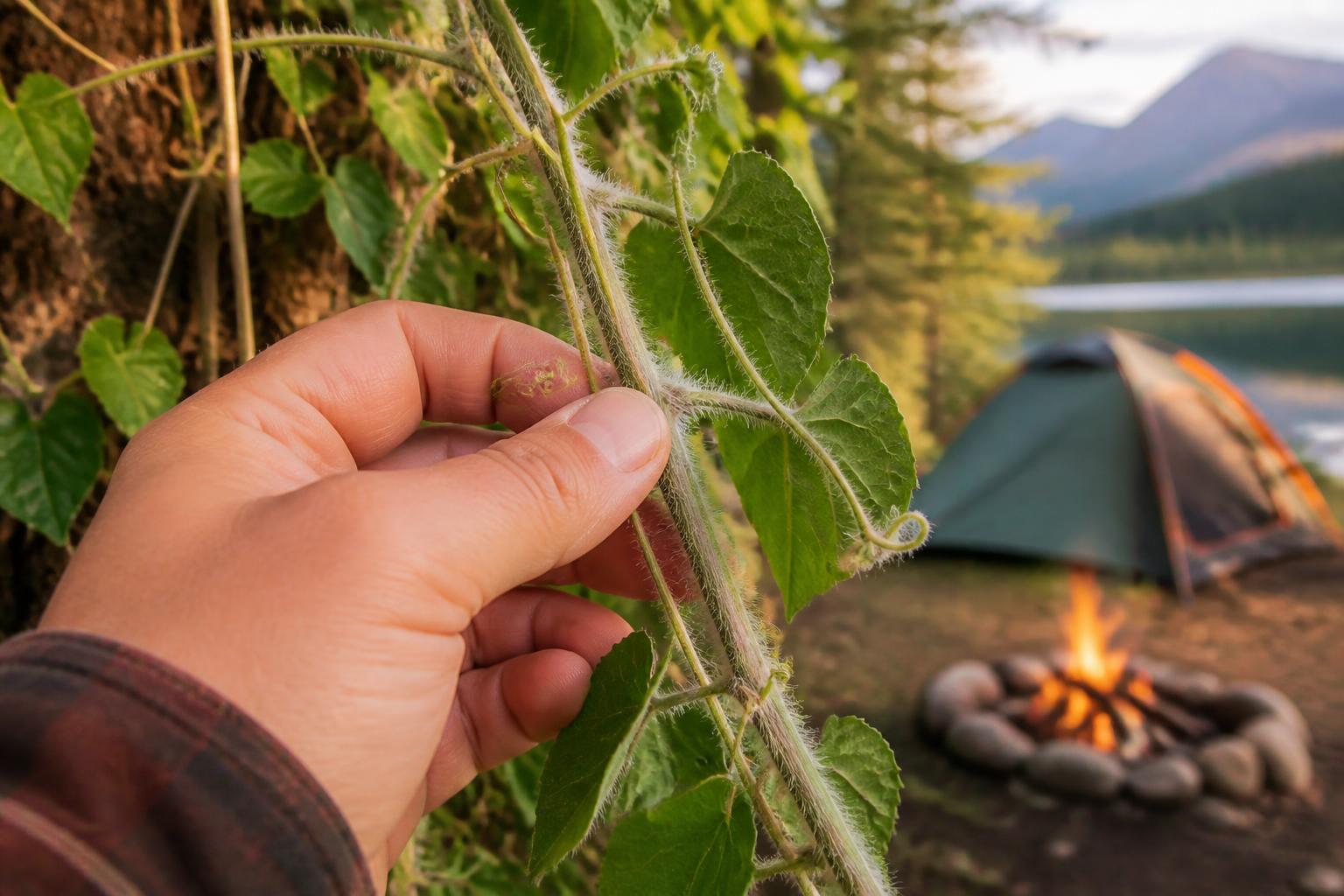
The leaf stalks (petioles) are often reddish, especially near where they join the main stem. This red tint is a strong clue but not foolproof – some non-toxic plants also have red stems. Use it as supporting evidence, not your only check.
Vine or Shrub? Recognizing Growth Habits and Hairy Vines
Poison ivy can grow as a ground cover, a low shrub up to 3 feet tall, or a climbing vine. The growth habit changes with its environment, but the vine form gives you the most unmistakable clue.
Climbing Vine: The “Hairy” Hairs
When poison ivy climbs a tree, fence, or wall, it produces a thick, woody vine covered in short, wiry, brown aerial roots that look like fuzzy fibers clinging to the surface. Run your gloved hand over it – you will feel a rough, bristly texture. This is not thorns (which brambles have) and not adhesive discs (which Virginia creeper uses). The fuzzy roots are unique to poison ivy and poison oak. If the vine is smooth or thorny, it’s a different plant.
Shrub Form: No Vine, Same Risk
In an open field or along a trail, poison ivy often stays as a compact shrub 1–3 feet tall. You won’t see a climbing vine. Without the vine clue, rely on leaf arrangement and the other leaf features. The stem may still show a reddish tint, and the leaves still come in threes.
Berries as a Confirmatory Sign
Mature poison ivy produces small, off-white or waxy white berries in drooping clusters. These appear in late summer and fall. Red or blue berries mean you’re looking at a different plant – Virginia creeper has blue-black berries, and sumac has fuzzy red berries. White berries are a near-certain sign of poison ivy (or poison oak).
Top Look-Alike Plants and How to Tell Them Apart
Several harmless (and one toxic) plants share the “leaves of three” look. The table below gives you the one decision criterion that changes your recommendation: check leaf arrangement first, then vine texture.
| Look-Alike | Key Difference from Poison Ivy |
|---|---|
| Boxelder saplings (Acer negundo) | Leaves are opposite on the stem. Poison ivy is always alternate. Also, boxelder has five or seven leaflets on mature leaves, but saplings often have three. |
| Virginia creeper (Parthenocissus quinquefolia) | Usually has five leaflets, but young shoots can have three. The vine has adhesive discs (look like tiny suction cups), not fuzzy brown roots. Berries are blue-black. |
| Brambles (blackberry, raspberry, Rubus spp.) | Stems are covered in thorns. Poison ivy stems have no thorns. Leaves are often toothed and can be hairy. |
|
| Fragrant sumac (Rhus aromatica) | Leaves are alternate like poison ivy, but the leaflets are serrated and the plant smells strongly of citrus when you crush a leaf. Poison ivy has no distinct odor. Also, fragrant sumac has red berries. |
| Poison oak (Toxicodendron diversilobum) – mostly west of the Rockies | Leaves are lobed like oak leaves, but it’s just as toxic as poison ivy (same urushiol oil). Follow the same identification rules: alternate leaves, fuzzy vine, white berries. Treat both with equal caution. |
The one decision criterion that changes the recommendation: When you spot a three-leaflet plant, stop and check the leaf arrangement on the stem. If the leaves are opposite each other, you can safely handle the plant (it’s boxelder or a similar non-toxic species). If the leaves are alternate, then examine the vine (if present). A fuzzy, hairy vine means poison ivy (or poison oak) – stay away. A smooth or thorny vine means a safe plant.
Poison Ivy ID Checklist
Use these five checks before you decide to touch or avoid a plant. All must be true for a positive identification of poison ivy.
- [ ] Three leaflets – The leaf is compound with exactly three leaflets. (Rarely more, but if you see five, it’s likely Virginia creeper.)
- [ ] Alternate leaf arrangement – Each leaf stalk attaches at a different height on the stem, not directly across from another leaf.
- [ ] No thorns – The stem and vine are smooth to the touch. Any thorns mean brambles.
- [ ] White or off-white berries (if present) – Waxy, drooping clusters. Red, blue, or black berries mean a different plant.
- [ ] Fuzzy vine (if climbing) – Short, wiry brown roots cling to the surface like coarse hair.
If all five checks pass, assume it’s poison ivy and avoid contact. If any one check fails, the plant is likely safe – but if you’re still unsure, keep your distance.
What to Do If You’ve Touched Poison Ivy
Time is your only real defense. The urushiol oil that causes the rash can bond to skin in as little as 10–15 minutes. Here’s a concrete action plan that stops the oil before the rash starts.
Preparation: Keep a dedicated poison ivy scrub (like Outdoor Hands Poison Ivy Scrub or Tecnu Extreme Poison Ivy & Oak Scrub) in your car or first-aid kit. Regular soap and water work too, but a specialized exfoliating scrub lifts more oil off the skin.
Early checkpoint – time elapsed:
– Under 15 minutes: Wash immediately with cool water and scrub. You have a high chance of preventing the rash entirely.
– 15–30 minutes: Wash as soon as possible. The rash will likely be milder and more localized.
– Over 30 minutes: Wash anyway – some oil may still be removable, but the rash will probably develop.
Ordered steps:
- Wash exposed skin with cool water and a generous amount of soap or poison ivy scrub. Scrub for at least 20 seconds, paying special attention to nails, between fingers, and any skin that may have brushed against the plant.
- Wash all clothing, shoes, and tools with warm water and detergent. Urushiol can stay active on surfaces for months. Handle them with gloves.
- Rinse pets if they ran through the plant. Wear gloves and use pet-safe shampoo.
- Apply a calamine lotion or an anti-itch cream if a rash appears. Ivarest Poison Ivy Itch Cream provides medicated relief for up to 8 hours.
- Monitor for escalation. If you develop any of the following, stop home care and seek medical attention:
- A rash covering more than 10% of your body (roughly the size of your arm from shoulder to wrist).
- Swelling around the eyes, mouth, or genitals.
- Difficulty breathing or swallowing.
- Fever over 100.4°F.
- Severe blistering that oozes or appears infected.
Success check: If you washed within 15 minutes and no rash appears within 48 hours, you avoided the reaction. If a rash does appear, it will typically peak in 1–5 days and then fade. Persistent itching, spreading redness, or pus are signs of bacterial infection and require a doctor visit.
Frequently Asked Questions
Can poison ivy have five leaflets?
Rarely. Mature plants almost always have three leaflets. If you see five, it’s almost certainly Virginia creeper – but double-check the vine texture and berries to be safe.
Does poison ivy grow in every state?
Poison ivy is found throughout the US except in Hawaii, Alaska, and some parts of the Southwest desert. Poison oak (also toxic) is more common on the West Coast.
Is it safe to pull poison ivy while wearing gloves?
Yes, but use disposable nitrile or heavy rubber gloves – urushiol can soak through latex and thin fabric. After pulling, seal the plants in a plastic bag and dispose of them in the trash. Never burn poison ivy; the smoke carries urushiol and can cause severe lung irritation.
How long does it take for a rash to appear?
Typically 12 to 48 hours after contact, but it can appear as early as 4 hours or as late as 10 days, depending on the amount of oil and your skin sensitivity.

Camping Bob has spent over 20 years camping across the US — from BLM dispersed sites in the Southwest to KOA campgrounds in the Pacific Northwest. He writes practical, no-nonsense guides to help fellow campers get outdoors with confidence.