
What to Do If You Get Lost While Camping: Survival Steps
If you realize you’re lost, stop moving immediately. Sit down, drop your pack, and take ten slow breaths. Panicked walking burns water, widens your search radius, and makes you harder to find. The fastest way to get rescued is to stay in one place and signal.
The Single Mistake That Delays Rescue
Most lost campers don’t admit they’re lost for at least an hour. They convince themselves the trail is just over the next ridge, and every wrong step turns a minor misdirection into a mile-deep problem.
How to detect it early: If you haven’t seen a trail marker, a familiar landmark, or any sign of your intended path in 30 minutes—stop. The same applies if the terrain doesn’t match the mental map you built at the trailhead. That mismatch is reliable data, not failure. Acknowledge it and commit to staying put.
The STOP Protocol: A Step-by-Step Decision Framework
Use the STOP mnemonic to regain control before panic takes over.
Stop
Sit down, lean against a tree or rock, and focus on your breathing. Physical movement now makes the situation worse. Your only job in the first five minutes is to break the adrenaline loop.
Think
- What time is it? How much daylight remains?
- Do you have at least 24 hours of water? Food is a distant second priority.
- Did you tell anyone your approximate route and return time? If yes, searchers have a starting point.
- What gear can you use for signaling (whistle, mirror, bright fabric) or shelter (tarp, emergency bivvy)?
Observe
- Look at the ground—do you see your own footprints or others’? Which direction were they heading?
- Scan the horizon for power lines, roads, watercourses, or clearings. Pick three fixed reference points (e.g., a rocky peak, a dead snag, a creek bend). Write them down mentally—do not walk toward them yet.
- Check the sky for storm signs. If rain or darkness is within an hour, shelter becomes your top priority.
Plan
Choose one of two actions:
1. Stay put – This is the default if you told someone your route. Build a visible signal (bright clothing, rock SOS, whistle blasts).
2. Move only if – you have no water where you are, you can see a downhill drainage that leads to a road or stream, and you still have at least two hours of daylight. Travel slowly, marking your path with rock cairns or broken branches every 50 feet.
When to Stay vs. When to Move: The Critical Trade-Off
Applicability boundary: The advice below assumes you are lost in a well-trafficked camping area with established rescue infrastructure (national park, state forest, RV park). If you are on a remote expedition with no cell service and nobody knows your route, the timeline shifts from hours to days—water procurement and shelter become urgent, and moving to a reliable water source is often necessary. In those cases, wilderness survival training is required beyond these general steps.
The trade-off: Moving to find water trades safety for hydration. You may walk away from your pack, food, shelter, and your most likely search point. The gain is only worth it if you are certain a water source is within a half-mile and you have at least two hours of daylight. Otherwise, staying put is statistically safer—most lost campers are found within the first 12 hours, but only if they stay in one place.
Verification step: To confirm you are actually lost (not just temporarily confused) before committing to a plan: pull out a paper map (if you have one) and try to identify three landmarks you can see from where you are. If you can match one of them to the map, you are not lost—you’re disoriented. Orient the map physically and pick a bearing to backtrack. If you cannot match a single landmark, you are genuinely lost. Stay put.
Practical implication for your next trip: Now is the time to pack a whistle, a signal mirror, and a paper map before you head out. If you rely solely on a phone GPS, you have no backup when the battery dies at 20%. The real test: can you signal for help without electronics? If not, your survival strategy has a gap.
3 Expert Tips for Staying Found
Tip 1: Signal before you settle.
– Actionable step: As soon as you stop, blow your whistle in three short bursts (the universal distress signal). Repeat every 15 minutes. A whistle carries much farther than a shout and requires almost no energy.
– Common mistake: Waiting until dark to signal. Daylight gives visual contact for searchers; sound carries better in still morning or evening air, but visual trump’s audio—signal immediately.
Tip 2: Make yourself visible from the air.
– Actionable step: Lay a bright tarp, tent fly, or sleeping pad in an open area. Spell “X” or “SOS” with rocks or logs. Aim for at least a 6-foot-wide pattern.
– Common mistake: Hiding under dense canopy. Move 50 yards to a clearing if it’s safe. Searchers flying overhead cannot spot you through thick evergreen cover.
Tip 3: Ration your water from the start.
– Actionable step: Consolidate all water into one container. Drink 3–4 ounces per hour in mild weather. Do not exceed 6 ounces per hour unless you are sweating heavily.
– Common mistake: Finishing your bottle in the first 30 minutes because “you’ll find a stream.” You likely won’t, and moving to find one risks worsening your position. Morning dew is a better short-term source; wipe a bandana over grass and suck the moisture.
Operator Flow: First 60 Minutes
This flow assumes you recognized you’re lost within the first hour. Adjust based on daylight and gear.
Minute 0–5: Break the panic
– Sit down. Drop your pack. Take five slow, deep breaths.
– Say aloud: “I am lost. I will stay here unless I have a compelling reason to move.”
– Check your phone—if you have any signal, call 911 or send a text. Immediately put the phone in airplane mode to save battery.
Minute 5–15: Inventory and first signal
– Empty your pockets: whistle, lighter, knife, headlamp, mirror, any bright cloth.
– Blow three whistle bursts. Note the time. Repeat every 15 minutes.
– Set out bright gear in a visible clearing—50 feet from your shelter site if needed.
Minute 15–30: Build shelter if night or rain is close
– Use a tarp, emergency bivvy, or fallen branches to create a windbreak. Make sure the shelter is visible from a distance—don’t bury yourself under deep pine.
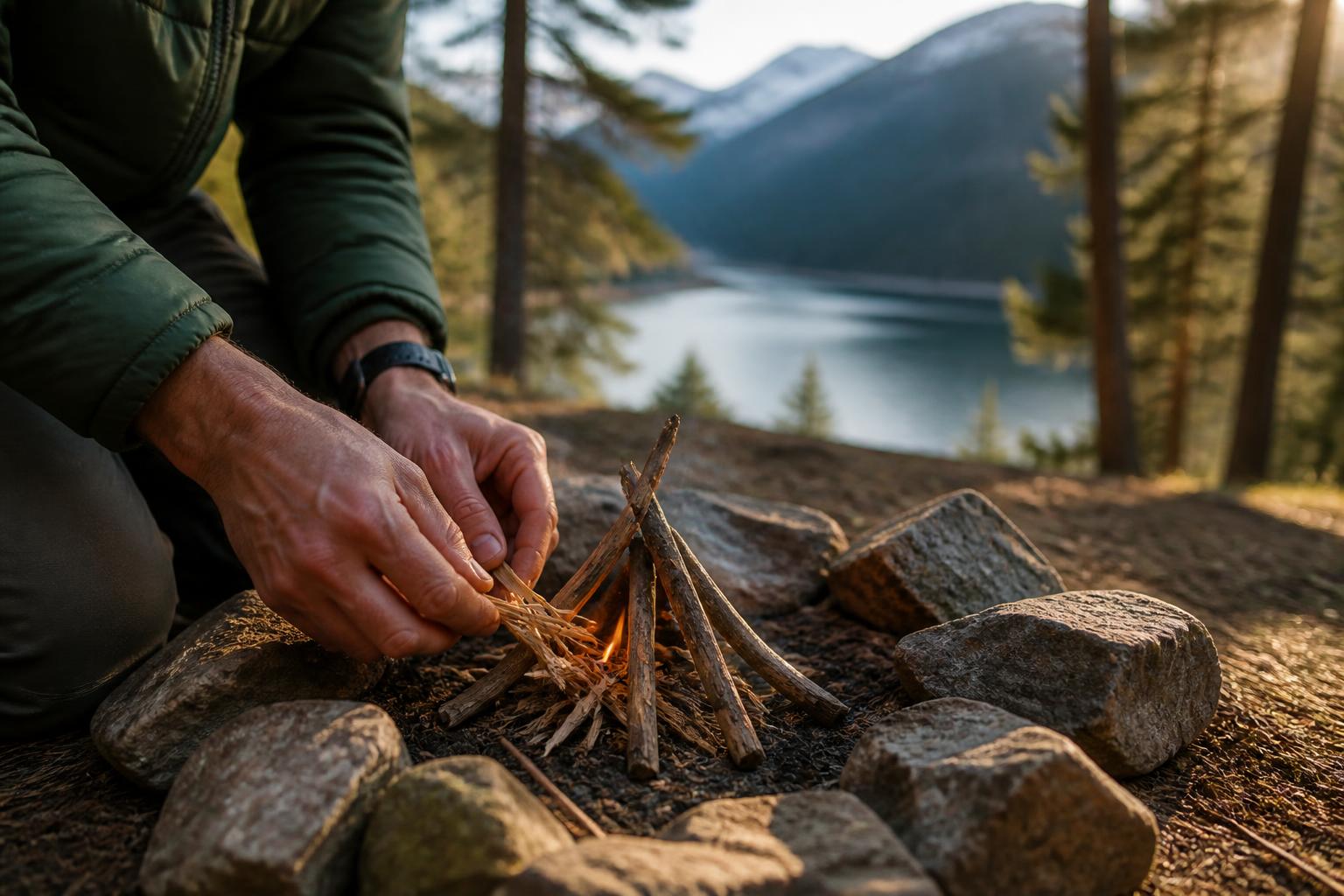
– Gather dry tinder and kindling for a signal fire (light it only if you hear a plane or helicopter).
Minute 30–60: Observe and make the stay/move decision
– If you have water and shelter, stay. Mark the area with a large ground signal—spell SOS with rocks if you have energy.
– If you have no water and can’t collect rain, and it’s midday with clear weather, consider a controlled descent downhill toward a drainage. Walk slowly, stopping every 100 feet to reassess. Mark your trail.
– Checkpoint: After 60 minutes, if you haven’t seen or heard searchers, repeat the whistle series and increase the size of your ground signal.
Escalation signal: If you have a serious injury, severe dehydration, or no shelter and a storm is arriving, light a signal fire immediately. Use green branches to create heavy smoke—searchers look for that during daylight.
Success check: You see a trail, a vehicle, or hear a human voice at a distance you can safely reach before dark. Otherwise, stay put. Rescuers often find lost people in the first 24 hours—but only if those people stay in one place.
Frequently Asked Questions
What if I don’t have a whistle?
Bang two rocks together or strike a metal object (water bottle, knife blade) against a rock. Three loud impacts, pause, repeat. The pattern is more recognizable than random noise.
What if I see a trail but I’m not sure it’s the right one?
Do not take it unless you can confirm it leads to a known landmark or road. Mark your current position (leave a boot, a bright item, or an arrow scratched in dirt) and walk 50 feet down the trail. If it doesn’t match your memory, return to the mark.
How long should I wait before moving?
At least two hours after you first stopped, unless you face an immediate threat (wildfire, flood, zero water). Searchers are most effective during the early hours, and staying put maximizes the chance they follow your original route.
Can I use my phone’s compass or GPS?
Yes, but only if you have a clear idea of where you started and can see the sun or north star to cross-check the compass reading. Do not blindly follow a digital bearing—battery drain and magnetic interference often lead to false confidence.
Should I climb a hill for a better view?
Only if you can reach the top in 15 minutes and return to your pack. If you can’t, you risk losing your gear and your reference point. A safer bet is to mark your pack and climb a nearby rise that takes no more than five minutes—then return immediately.

Camping Bob has spent over 20 years camping across the US — from BLM dispersed sites in the Southwest to KOA campgrounds in the Pacific Northwest. He writes practical, no-nonsense guides to help fellow campers get outdoors with confidence.