
Understanding Pop-Up Camper Costs: A Buyer’s Guide
Quick answer
- New pop-up campers range from $5,000 to $30,000+.
- Used pop-ups can be found for $1,000 to $15,000+.
- Factor in setup, maintenance, insurance, and storage costs.
- Smaller, basic models are cheaper; larger, feature-rich ones cost more.
- Consider the long-term value vs. initial price.
- Don’t forget accessories and gear – they add up.
What to check first (do this before you drive out)
Before you even think about hooking up that pop-up and hitting the road, there are a few crucial things to nail down. This isn’t just about the camper itself; it’s about making sure your entire camping setup is ready to roll.
- Land manager / legality: Who actually owns and manages the land where you plan to camp? Is it a National Forest, BLM land, a State Park, or private property? Each has different rules about where you can park, campfires, and length of stay. Always check the official website or call the ranger station for the specific area. Ignorance here can lead to fines or being asked to leave.
- Access/road conditions: Can your tow vehicle actually get to your chosen spot? Some pop-ups are light, but if you’re planning on some off-the-beaten-path adventure, you need to know if that dirt road is more mud pit than trail. A standard sedan might be fine for a paved campground, but a 4WD with good clearance is a must for rougher terrain. Check maps and reviews for road conditions.
- Fire restrictions + weather + wind: This is a big one, especially in dry climates or during fire season. Are campfires allowed? What about charcoal grills? Check the local fire restrictions – they can change rapidly. Also, look at the weather forecast. Pop-ups, while cozy, aren’t built for severe storms. High winds can be a real issue when setting up and can damage the canvas.
- Water plan + waste plan (Leave No Trace): Where will you get your water? Are there potable water spigots, or do you need to pack it all in? And what about waste? If you’re in a dispersed camping area, you’ll need to pack out everything, including grey water from washing dishes. Know your plan for both before you go to avoid unpleasant surprises or environmental damage.
- Safety (wildlife, distance to help, comms): What kind of wildlife is common in the area? Bears, raccoons, snakes? Know how to store food properly and what to do if you encounter them. Also, how far is the nearest town or ranger station? Cell service can be spotty in the backcountry. Let someone know your itinerary and expected return time. A satellite communicator can be a lifesaver if you’re truly off the grid.
Step-by-step (field workflow)
Okay, you’ve got your pop-up, you’ve done your homework. Now it’s time to set it up. It’s a process, but once you get the hang of it, it’s pretty smooth.
1. Choose your spot: Find a level area, ideally with some shade. Make sure it’s a legal camping spot and you’re not too close to other campers if you want some peace.
- Good looks like: A flat surface where the camper won’t tilt, and you have room to open the canvas.
- Common mistake: Parking on a slope. This makes sleeping uncomfortable and can put stress on the camper’s frame. Always try to level it.
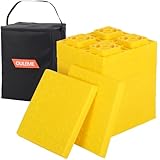
When choosing your spot, remember that even a slight incline can make sleeping uncomfortable. Consider using camper leveling blocks to ensure a perfectly flat surface for your pop-up.
2. Lower the tongue jack: Use the crank to lift the tongue of the camper and disengage the hitch from your tow vehicle.
- Good looks like: The camper is stable on its own jack, and the hitch is clear of the ball mount.
- Common mistake: Forgetting to fully lower the jack. This can leave the camper unstable or even cause it to roll if not properly chocked.
3. Chock the wheels: Place wheel chocks firmly against the tires to prevent rolling.
- Good looks like: Solid, secure chocks on both sides of both tires.
- Common mistake: Skipping this step. A camper rolling downhill is a disaster waiting to happen.
4. Level the camper: Use the stabilizer jacks at each corner to get the camper perfectly level side-to-side and front-to-back.
- Good looks like: A bubble level shows you’re perfectly balanced. No rocking when you walk inside.
- Common mistake: Relying only on the tongue jack. Stabilizer jacks are crucial for stability once the camper is unhitched.
To achieve that perfect balance, don’t forget your camper leveling blocks. They are essential for getting your pop-up perfectly level side-to-side and front-to-back, ensuring a stable and comfortable stay.
5. Open the roof: Most pop-ups have a latch or two on the roof. Release them and lift the roof. Some are easier than others.
- Good looks like: The roof lifts smoothly and locks into its raised position.
- Common mistake: Forcing it. If it’s stuck, check for obstructions or misaligned latches.
6. Extend the beds: Pull out the sleeping platforms on each end. These usually slide out on rails.
- Good looks like: The beds slide out smoothly and lock into place.
- Common mistake: Not pulling them out all the way, or not securing them properly. This can lead to instability.
7. Raise the canvas: Unfold and pull out the canvas tent sections.
- Good looks like: The canvas is taut, with no major wrinkles or sagging.
- Common mistake: Leaving canvas bunched up. This can lead to mildew and make it hard to zip up later.
8. Secure the canvas: Attach the canvas to the roof and bed ends using the provided snaps, Velcro, or zippers.
- Good looks like: A tight seal all around, keeping bugs and weather out.
- Common mistake: Rushing this. A poor seal means drafts, bugs, and potential water leaks.
9. Set up the interior: Unfold dinettes, beds, and set up any furniture.
- Good looks like: Your living space is functional and comfortable.
- Common mistake: Leaving folded items blocking pathways. Make sure you can move around freely.
10. Hook up utilities (if applicable): Connect water, power, or propane if you’re using them.
- Good looks like: All systems are functioning correctly and safely.
- Common mistake: Forgetting to turn off propane before connecting lines, or not checking for leaks.
Common mistakes (and what happens if you ignore them)
| Mistake | What it causes | Fix |
|---|---|---|
| Not leveling the camper | Uncomfortable sleeping, water pooling, stress on frame | Use a bubble level and stabilizer jacks religiously. |
| Forgetting to chock wheels | Camper rolling away, potential damage to camper and surroundings | Always chock wheels <em>before</em> unhitching or leveling. |
| Rushing canvas setup | Drafts, bugs, water leaks, mildew, difficult to pack up | Take your time to ensure a tight, proper seal. |
| Not checking tire pressure | Poor towing, blowouts, uneven wear, reduced fuel economy | Check pressure before every trip, and ensure it matches the tire sidewall rating. |
| Ignoring fire restrictions | Fines, wildfire, damage to campgrounds | Always verify current restrictions with the land manager. |
| Overpacking the camper | Stress on suspension, difficult towing, potential damage | Pack smart, distribute weight evenly, and know your camper’s Gross Vehicle Weight Rating (GVWR). |
| Not securing bed platforms | Beds collapsing, unsafe sleeping conditions | Ensure locking mechanisms are engaged fully. |
| Forgetting to lower stabilizer jacks | Camper feels wobbly, potential damage to jacks if driven with them down | Lower them only after the camper is leveled and unhitched. |
| Improper food storage (wildlife) | Attracting unwanted visitors, potential danger, damage to camper | Use bear-proof containers or secure food in your vehicle. |
| Driving with roof or beds up | Catastrophic damage to camper, tow vehicle, and overhead structures | Double-check everything is stowed and latched before driving. |
| Not performing regular maintenance | Component failures, costly repairs, reduced lifespan of the camper | Follow a maintenance schedule for canvas, seals, brakes, bearings, and frame. |
| Assuming all campsites are the same | Arriving at a spot that’s inaccessible or unsuitable for your camper | Research site specifics – road conditions, size, amenities. |
One common mistake is not leveling the camper, which can lead to uncomfortable sleeping and stress on the frame. Always use a bubble level and reliable camper leveling blocks to ensure your pop-up is perfectly flat.
Decision rules (simple if/then)
- If the forecast calls for severe thunderstorms, then postpone your trip because pop-up canvas offers little protection.
- If you’re new to towing, then practice in an empty parking lot before hitting the highway because it builds confidence.
- If you plan to camp in bear country, then invest in a bear canister or proper food storage because it’s for your safety and the bears’.
- If the road to your campsite looks rough, then consider if your tow vehicle and the camper’s clearance can handle it because getting stuck is a bad time.
- If you see a “No Camping” sign, then find another spot because it’s not worth the risk of a ticket or fine.
- If you’re unsure about water availability, then pack extra water because dehydration is no joke.
- If you’re setting up in windy conditions, then stake down the canvas extra securely because a flapping tent is annoying and can tear.
- If you’re buying used, then bring a flashlight and a friend to inspect everything thoroughly because hidden problems can cost you big.
- If you plan to use propane appliances, then check your propane levels before leaving because running out mid-trip is a bummer.
- If you’re camping in mosquito season, then bring plenty of bug spray and consider a screen house because mosquitos can ruin an otherwise great trip.
- If you’re on BLM or National Forest land, then check for dispersed camping rules because they vary widely.
- If you hear wildlife near your camp at night, then stay in your camper and make noise because you don’t want to surprise them.
FAQ
How much do new pop-up campers typically cost?
New pop-ups can range anywhere from $5,000 for a basic, smaller model to $30,000 or more for larger, feature-packed units with amenities like bathrooms and full kitchens.
What’s a reasonable price for a used pop-up camper?
You can find used pop-up campers for as little as $1,000 for older, simpler models needing some work, up to $15,000 for a relatively newer, well-maintained unit with more features.
Are there hidden costs associated with owning a pop-up camper?
Absolutely. Beyond the purchase price, budget for insurance, maintenance (like canvas repair or seal replacement), propane, accessories, and potentially storage fees if you don’t have space at home.
Does the size of a pop-up camper significantly affect the price?
Yes, larger pop-ups with more sleeping capacity and amenities will generally cost more than smaller, more basic models. Think of it like square footage in a house.
What are the most important features to consider when buying a pop-up?
Consider sleeping capacity, whether you want a bathroom or shower, kitchen amenities (indoor/outdoor), storage space, and the overall build quality and weight for your tow vehicle.
How do I know if my tow vehicle is capable of pulling a pop-up camper?
Check your vehicle’s owner’s manual for its towing capacity. You’ll also need to consider the camper’s Gross Vehicle Weight Rating (GVWR) and ensure it’s well within your vehicle’s limits, factoring in passengers and gear.
Is it worth buying a pop-up camper if I only camp a few times a year?
It depends on your budget and how much you value the convenience. Renting is an option, but if you plan to camp regularly, the investment can pay off in freedom and personalized trips.
What kind of maintenance do pop-up campers require?
Regular checks of the canvas for tears and mildew, seals around windows and doors, tire pressure, brakes, and the structural integrity of the frame are essential. Lubricating moving parts also helps.
What this page does NOT cover (and where to go next)
- Specific campsite reservation systems and booking details.
- Detailed towing techniques and vehicle-specific hitch requirements.
- In-depth guides on repairing canvas or structural components.
- Legal requirements for RV registration and driver’s licenses in your specific state.
- Advanced backcountry navigation and survival skills.

Camping Bob has spent over 20 years camping across the US — from BLM dispersed sites in the Southwest to KOA campgrounds in the Pacific Northwest. He writes practical, no-nonsense guides to help fellow campers get outdoors with confidence.