
Pop-Up Tent Setup and Takedown: The Complete Guide
Pop-up tents unfold in seconds—just pull them from the bag and release. The hard part is getting them back down. Most owners struggle because the correct fold isn’t obvious. Here’s exactly how to set up and take down a pop-up tent, including the figure-8 fold that works for most models, plus how to handle common problems.
Before You Start: What to Check
- Tent bag or carry straps – Keep them close. You’ll use the bag as a guide for the final fold.
- Flat, clear ground – Move rocks, sticks, and debris. A tent with fabric bunched under the poles is much harder to collapse.
- No strong wind – Pop-ups catch air like a sail. In gusts over 10 mph, set up with a friend holding the frame, or wait for calmer conditions.
- Check for a folding diagram – Some brands, including Night Cat Pop Up Tent, 2-3 Persons Instant Camping Tents with Footprint Tarp & Rainfly, include a diagram or video QR code. Find it before you start.
Setup in 3 Steps
- Unzip the carry bag and remove the tent. Hold it by the center hub or by the top of the pole frame—not by the fabric.
- Give the tent a gentle toss onto flat ground. The pre-attached poles spring open automatically. Models like the Londtren Pop Up Tents for Camping 4 Person Waterproof open as soon as you release the straps. If the tent only partially opens, shake the fabric loose from the poles rather than forcing it.
- Spread the base and stake down. Walk around pushing the floor flat, then insert stakes at all loops (usually 4–6 points). Attach the rainfly if included.
Early checkpoint: The tent should stand straight with no sagging panels. If a pole segment is visibly bent or twisted, stop—the pole may be misaligned. Disassemble and re-spread the base. If it still won’t sit flat, one of the pole hubs may be rotated wrong; check for a twist in the frame before proceeding.
Takedown in 5 Steps (The Hard Part)
This is where most people fail. Pop-ups use a collapsible pole frame that must fold in a specific pattern. The figure-8 method works for most brands.
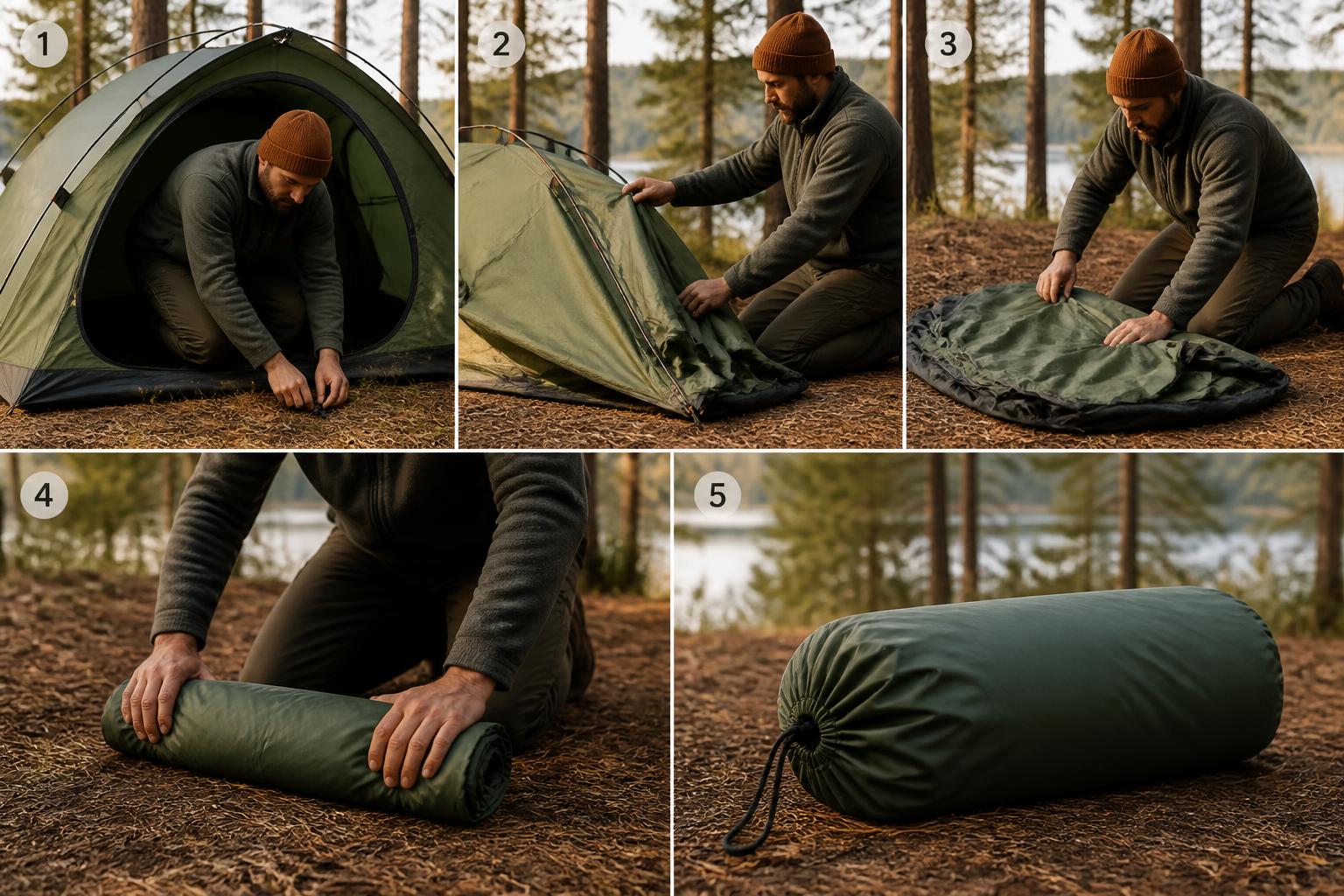
- Remove all stakes, rainfly, and loose items. Unzip doors and windows to release trapped air. Shake out debris inside.
- Lie the tent flat on the ground with the door facing up. Push the roof down until the tent is a flat disk. The poles should naturally settle into two or three rings. If they don’t, you likely have fabric bunched under the frame—lift the tent and re-spread it.
- Grab two opposite sides of the pole frame (the “ears” of the tent). Bring them together so the tent folds into a crescent shape, like a taco.
- Fold the crescent in half to create a figure-8. The poles collapse into two overlapping circles. Some tents need a second twist: for Night Cat models, “fold like a number 8 and repeat twice” (from the manual). Press the circles flat using your knee to compress the bundle.
- Wrap the carry bag or strap around the compressed tent to hold it closed. Slide the bag over the bundle or secure the built-in straps.
Success check: If the tent fits easily back into the bag with no bulging, you got the fold right. If it’s still too large or a pole end sticks out, you missed a crease—unfold and restart from step 3.
When to Stop and Change Your Approach
Most pop-ups fold the same way, but not all. If you’ve tried the figure-8 fold twice and the tent still won’t collapse flat, stop forcing it. Some tents, especially budget models with thick pole rings, require a tri-fold or triangular crush fold where the flat disk is folded into thirds instead of a taco. Check your manual or search for a video of your specific model. Forcing a figure-8 on a tent designed for a tri-fold can snap the elastic cord inside the poles.
Escalate if You See This
If you hear a sharp crack during folding, feel sudden resistance from inside a pole segment, or see exposed cord ends poking from the pole tips, stop immediately. The internal elastic cord that holds the pole segments together may be broken or stretched out. Continuing to force the fold can snap a pole hub or rip the fabric. This is a repair or warranty situation—most manufacturers cover broken elastic cords under the first year. Contact the brand’s customer support rather than trying to replace the cord yourself (it’s rarely worth the time).
Common Takedown Problems & Fixes
| Problem | Likely Cause | Solution |
|---|---|---|
| Poles won’t collapse | Tent is twisted or fabric is bunched | Lay tent absolutely flat; unzip all panels; pull fabric away from pole hubs |
| Tent fits but one pole sticks out | Final fold not tight enough | Re-compress the circles with knee pressure; the bundle should be evenly thick |
| Fabric snags on pole ends | Pole tips are exposed | Tuck pole ends under the fabric before the final fold |
| Tent pops open while folding | You skipped a crease; tension is unbalanced | Start over—do not force it; you can damage the internal elastic cord |
| Figure-8 fold doesn’t work at all | Your model uses a different folding pattern | Search for “tri-fold pop up tent” or your model name + “folding instructions” |
Pop-Up Tent Fit Check (Decision Aid)
Before buying or using a pop-up tent, run through these 5 checks:
- [ ] Folding method: Can you find a video or diagram for this specific model? If not, the takedown may be unintuitive and harder to learn.
- [ ] Bag size: The carry bag should be just slightly larger than the folded disc. If the bag is too tight, the tent will be difficult to re-pack.
- [ ] Pole material: Fiberglass poles are common and affordable but can crack in cold weather below freezing. Steel poles are heavier but stiffer. Check the manual for pole type.
- [ ] Weather resistance: Most pop-ups handle light rain and mild wind. For storms, you need a separate rainfly and well-seated stakes. If you camp in exposed, windy areas, a dome tent may be safer than a pop-up.
- [ ] Practice space: The first takedown always takes longer. Test at home on a lawn or carpet before camping—don’t learn the fold on site with rain coming.
When a Pop-Up Tent Makes Sense (and When It Doesn’t)
Pop-ups are ideal for quick overnights, festivals, and car camping where you want to avoid pole assembly. They are not a good fit for backpacking (too heavy and bulky) or for high-wind conditions (the flat sides catch more wind than dome tents). If your main constraint is setup time and you’re driving to camp, a pop-up is a strong choice—once you practice the fold at home. If you’re hiking to your site or camping in exposed alpine terrain, choose a standard dome tent instead. With practice, the figure-8 fold becomes routine, and the takedown time drops under two minutes.

Camping Bob has spent over 20 years camping across the US — from BLM dispersed sites in the Southwest to KOA campgrounds in the Pacific Northwest. He writes practical, no-nonsense guides to help fellow campers get outdoors with confidence.