
Tents and Shelters: The Complete Guide to Camping Shelter
The best shelter for your trip comes down to one core decision: how you camp. Car campers can haul a heavy, roomy tent with thick fabric. Backpackers need a shelter that packs small and weighs under 5 pounds. Families want standing height and separate rooms. Once you pick your style, the rest of the specs – fabric denier, pole type, floor material – fall into place.
Start With Your Camping Style
Your camping style sets the weight and size limits. A tent that works for a walk-in campsite will feel like a brick in your pack on a 10-mile hike.
Car Camping Tents – Prioritize Space and Durability
You drive to the site, so weight doesn’t matter. Look for:
– Fabric at least 60 denier (70–150 is common for car-camping models). Thicker fabric resists punctures from tent stakes and camp chairs.
– A full-coverage rainfly that reaches the ground.
– 75+ inches of interior length and 48+ inches of peak height so you can sit up.
– A bathtub floor (coated nylon or polyester, sewn with taped seams) to keep water out.
Example: A 6-person dome tent with two rooms and a screened porch will weigh 20+ pounds – fine for car camping, impossible to backpack.
Backpacking Tents – Prioritize Weight and Packed Size
Every ounce counts. Key specs:
– Total weight under 5 pounds for a 2-person model (split between two hikers, that’s 2.5 lb each).
– Packed size that fits inside your pack, not strapped to the outside.
– Denier 20–40 for the fly and floor – light but still durable enough for three-season use.
– Freestanding design (self-supporting poles) so you can pitch on tent pads, sand, or snow.
Trade-off: Ultralight tents often use thinner fabric and require trekking poles for setup. They cost more ($300–$600) but save 2–3 pounds compared to budget models.
Family Tents – When Multiple Rooms or Standing Height Matters
For groups of 4+ or trips with kids, look for:
– Center height 6 feet or more so adults can stand.
– Divided rooms or removable walls to create separate sleeping areas.
– Massive vestibules to store gear, muddy boots, and coolers.
– Color-coded poles and clips for quick setup – a must when assembling in the dark with tired children.
Reality check: A 10-person family tent can weigh 35–50 pounds. It needs two adults to set up and a campsite large enough to hold it.
Key Fabric and Construction Trade-Offs
Fabric denier (D) is the main durability signal, but it’s not the only one.
| Feature | What to Look For | Why It Matters |
|---|---|---|
| Floor fabric | 70D–150D for car camping; 20D–40D for backpacking | Higher denier → heavier but more puncture-resistant. A 150D floor can handle repeated setups on rocky ground. |
| Rainfly coating | Silicone-impregnated (silnylon) or polyurethane (PU) with a hydrostatic head of 1,500–3,000 mm | 1,500 mm handles light rain; 3,000 mm handles heavy downpours. Silnylon dries faster but costs more. |
| Seam sealing | Factory-taped seams on the fly and floor | Untaped seams leak at the stitch holes. If the tent isn’t factory taped, buy a sealant kit and do it yourself. |
| Pole material | Aluminum (DAC, Easton, generic) for durability; fiberglass for budget weight | Aluminum bends but doesn’t snap. Fiberglass is cheaper but can crack in cold weather or high wind. |
One concrete detail: Many budget tents advertise “150D floor” but use cheap polyester that abrades quickly. Look for ripstop nylon or polyester with a PU coating for real puncture resistance.
How to Choose the Right Size
Tent capacity ratings assume you sleep head-to-head without gear. In reality:
- 1-person tent: Fits one person and a small pack. Right for solo ultralight trips.
- 2-person tent: Tight for two adults with backpacks. Most couples buy a 3-person for comfortable sleep with gear inside.
- 3-person tent: Comfortably sleeps two adults plus gear, or two adults and a small child.
- 4-person and up: Each additional person adds about 2 feet of floor space. For a family of four, a 6-person tent gives room to move.
Rule of thumb: Subtract one person from the rating for a glamping-level of space. Add one person if you plan to stash gear outside the tent.
Tent Types and Their Best Uses
| Type | Best For | Key Advantage |
|---|---|---|
| Dome | All-purpose, car camping, light backpacking | Self-supporting, easy setup, wind-shedding shape |
| Tunnel | High-wind coastal or desert camping | Extremely stable when guyed out; packs long but narrow |
| Cabin | Family car camping with kids | Vertical walls for maximum headroom; heavy |
| Geodesic | Winter mountaineering, extreme weather | Multiple pole intersections handle snow loads and high winds |
| Trekking-pole shelter | Ultralight backpacking | Very light (1–2 lbs) but requires trekking poles and often has a single-wall design that can cause condensation |
Decision tip: If you camp in three-season conditions and aren’t a die-hard ultralight hiker, a dome tent is the most versatile and easiest to operate.
Decision Checklist: 7 Things to Verify Before Buying
Use this list when you’re in the store or scanning product pages:
- Weather rating: Does the rainfly cover the entire tent, and are the seams taped? A partial fly leaves mesh exposed, which wets out in sideways rain.
- Floor material: Is it a bathtub-style floor with taped corners? Rectangular flat floors let water seep in at the edges.
- Vestibule size: Can you store your pack and boots without blocking the door? Vestibules should be large enough to cook under (if stove camping) or at least keep gear dry.
- Ventilation: Are there dual-zippered vents in the fly? Condensation is the #1 comfort killer – you need airflow even in rain.
- Setup time: Have you watched a video setup? If it takes more than 10 minutes for a first-timer, consider a simpler pole configuration.
- Weight (if backpacking): Put the packed tent on a scale. “Trail weight” often excludes the stuff sack, stakes, and footprint.
- Warranty and repair policy: Does the manufacturer sell replacement poles and pole sleeves? A broken pole in the middle of a trip ruins your shelter.
Setting Up Your Shelter: A Quick Operator Flow
Even the best tent fails if it’s pitched poorly. Follow these checkpoints to get it right the first time.
Site Prep and Layout
- Clear the site of rocks, sticks, and pinecones. Place the tent footprint or ground tarp exactly where the tent will go – not a foot too far or rain will pool under the edge.
- Check for low spots where water would collect. If the ground slopes, orient the tent so the door faces downhill (prevents water from running in).
Pole Assembly and Body Attachment
- Lay out all poles. Color-code them if possible. Insert poles into sleeves or clip the body under each pole clip.
- For dome tents: lift the center hub or cross the poles at the top. The body should rise into a taught shape. If it looks floppy, one pole might be reversed.
- Checkpoint: Before staking, shake the tent gently. If the poles shift or the body sags, adjust the pole insertions.
Staking and Tensioning
- Stake all four corners at 45-degree angles away from the tent. Use the loops, not the seam.
- Tighten the guy-out lines (especially on the fly) to reduce flapping in the wind.
- Likely cause of sagging: The tent floor isn’t pulled taut. Re-stake corners in a diamond pattern – pull the opposite corner slightly tighter.
Weatherproofing Check and Verification
- Rainfly should sit 2–3 inches above the mesh to allow airflow. If it touches the mesh, condensation will soak the inner tent.
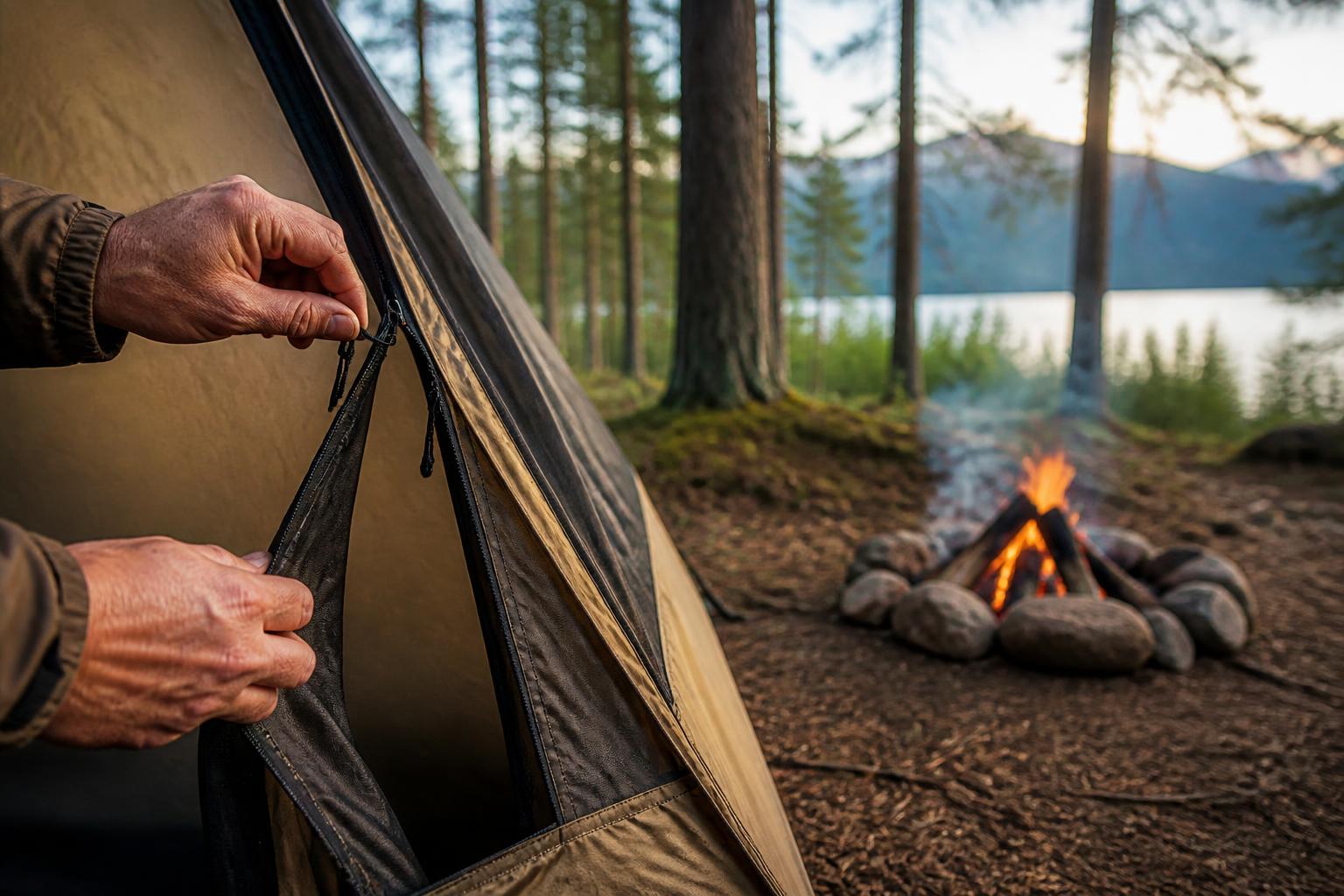
- Check that all zippers close completely and the storm flaps (if any) are buttoned or velcroed shut.
- Verification step: Pour a cup of water over the top of the fly. Water should bead and run off without pooling. Check inside the tent after 30 seconds – if you see any drips or dampness at the seams, the leak needs resealing before your trip.
- Success signal: The tent stands firmly without wobbling, the fly sheds water away from the door, and you don’t see daylight through seam gaps.
When to Stop DIY and Get Help
- Stop threshold: If a pole is cracked, splintered, or snapped (not just bent), stop trying to field-repair it. Duct tape or a splint might get you through one night, but the pole will fail under wind or snow load. Call the manufacturer for a replacement section. Most major brands (REI, MSR, Big Agnes, The North Face) sell individual pole segments or offer warranty replacements. Do not attempt to glue or weld a broken pole – it won’t hold.
- Failure mode to watch for: The most common recurring mistake is overtightening the rainfly, which pulls the pole structure out of alignment and creates a flat spot on the fly where water pools. Over time, pooled water seeps through the coating and soaks the interior. If you see a sagging water-filled pocket on your fly after setup, loosen the corner stake loops slightly and re-tension the guy lines from the fly itself, not the ground corners.
FAQ – Tents and Shelters Guide
What’s the difference between a 3-season and 4-season tent?
3-season tents have mesh walls for ventilation. 4-season tents use solid fabric panels and stronger poles to handle snow loads. For summer camping, a 3-season tent is lighter and breathes better.
Do I need a separate footprint?
Yes – a footprint protects your floor from punctures and keeps moisture out. Many tents include one, but you can cut a custom size from Tyvek if not.
How long should a tent last?
With proper care (dry storage, no UV exposure, seam resealing every 2–3 years), a good tent lasts 5–10 years. Cheap tents may only survive two seasons before zippers or coatings fail.
Can I use a backpacking tent for car camping?
Yes, but you’ll sacrifice space and durability. A 2-person backpacking tent will feel cramped, and the thin floor won’t handle repeated setups on gravel. Renting or borrowing is a better choice.

Camping Bob has spent over 20 years camping across the US — from BLM dispersed sites in the Southwest to KOA campgrounds in the Pacific Northwest. He writes practical, no-nonsense guides to help fellow campers get outdoors with confidence.