
Adding A Tarp Over Your Tent For Extra Protection
Quick answer
- A well-placed tarp offers serious rain, sun, and wind protection.
- Choose a tarp bigger than your tent footprint.
- Use good cordage and secure tie-outs.
- Angle it for water runoff.
- Keep it taut to prevent flapping.
- Stake it down solid.
- Consider a separate tarp for a gear shelter.
What to check first (do this before you drive out)
Before you even think about pitching, a little prep goes a long way. This isn’t just about making camp; it’s about making camp smart.
- Land manager / legality: Who owns this dirt? Is it National Forest, BLM, a state park, or private land? Different folks have different rules about camping, fires, and even where you can set up your tarp. Always check the official website or call the ranger station. You don’t want to be that person who gets a friendly (or not-so-friendly) visit from a land manager.
- Access/road conditions: Can your rig actually get there? Paved roads are one thing, but forest service roads can turn into a muddy mess fast. Know your vehicle’s capabilities – 2WD, 4WD, high clearance. A quick Google search for recent conditions or a call to the local ranger can save you a tow.
- Fire restrictions + weather + wind: This is a big one. Is there a burn ban? What’s the forecast? High winds can turn a tarp into a sail, or worse, rip it to shreds. Check multiple sources for weather, especially for mountain areas. Don’t guess.
- Water plan + waste plan (Leave No Trace): Where will rainwater go? You don’t want your tent to become a swimming pool. Plan your tarp setup to channel water away. And remember, pack it in, pack it out. Your tarp can help keep gear dry, but it doesn’t make trash disappear.
- Safety (wildlife, distance to help, comms): Are there bears? Are you miles from the nearest town? Make sure your campsite choice is safe. Tell someone where you’re going and when you expect to be back. Cell service is often a myth in the backcountry, so a satellite communicator is a smart move.
Step-by-step (how to put a tarp over a tent)
Alright, you’ve done your homework. Now it’s time to get that shelter dialed in.
1. Choose your spot: Find a relatively flat area for your tent. Clear away any sharp rocks or sticks.
- Good looks like: A smooth patch of ground that drains well.
- Common mistake: Pitching on a slope or right under a dead tree branch. Avoid these like the plague.
2. Lay out your tent: Position your tent where you want it.
- Good looks like: The tent door facing away from the prevailing wind or a scenic view, depending on your priority.
- Common mistake: Forgetting to orient the tent before you start rigging the tarp.
3. Unpack your tarp and cordage: Get everything out and organized.
- Good looks like: Tarp laid out, all stakes and guy lines accounted for.
- Common mistake: Trying to untangle knots or find missing stakes in the dark or rain.
4. Position the tarp: Drape the tarp over your tent, or position it to cover the tent with a gap. Aim for a higher point on one side if you want a sloped roof for rain runoff.
- Good looks like: Even coverage, with enough room to walk around your tent if desired.
- Common mistake: Not leaving enough sag or too much sag. You want it taut but not ripping your tent seams.
For reliable protection, consider a high-quality waterproof camping tarp. It will ensure your tent stays dry even in heavy downpours.
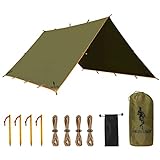
5. Secure the corners (initial): Use your stakes or tie-off points to loosely secure the main corners of the tarp.
- Good looks like: Corners anchored, but with some slack to adjust.
- Common mistake: Driving stakes in all the way too early. You’ll need to move them.
6. Create tension and shape: Use your guy lines and stakes to pull the tarp taut. If you’re aiming for a pitched roof, use trees, trekking poles, or higher stakes to create the angle.
- Good looks like: A drum-tight tarp with no flapping points. Water will shed off.
- Common mistake: Leaving loose spots that will flap in the wind and make noise all night.
To create optimal tension and shape for your tarp, especially for a pitched roof, adjustable trekking poles can be incredibly useful.

7. Add mid-points and extra tie-outs: Use any additional grommets or loops to further secure the tarp. This is crucial in windy conditions.
- Good looks like: The tarp is held firmly in multiple places, resisting wind.
- Common mistake: Relying only on the four corners. This is a recipe for disaster in bad weather.
8. Adjust for water runoff: Ensure the lowest points of your tarp are where you want water to collect or drain away from your tent.
- Good looks like: A clear path for water away from your tent walls and door.
- Common mistake: Creating a low spot that will pool water directly over your tent.
9. Final stake check: Make sure all stakes are driven in firmly at a 45-degree angle, away from the tarp.
- Good looks like: Staked down solid, ready for whatever nature throws at you.
- Common mistake: Not driving stakes deep enough, especially in soft ground.
10. Check guy line tension: Give each guy line a final tug. They should be snug but not overstretched.
- Good looks like: Everything is taut and secure.
- Common mistake: Over-tightening and potentially damaging your tarp or tent.
Common mistakes (and what happens if you ignore them)
| Mistake | What it causes | Fix |
|---|---|---|
| Tarp is too small | Tent is exposed to rain/sun | Get a tarp at least 1-2 feet larger than your tent footprint. |
| Not enough sag | Water pools on the tarp, can collapse or leak | Ensure a slight sag for water to run off, but not so much it flaps. |
| Too much sag | Water pools, can sag onto tent, less wind resistance | Keep it taut; use guy lines to pull it tight. |
| Not staking it down securely | Tarp flaps violently, tears, or blows away | Use all stake points and guy lines, drive stakes deep at an angle. |
| Tarp too close to tent fabric | Rain can wick up onto tent, condensation issue | Leave a gap; use trekking poles or extra lines to create space. |
| Ignoring wind direction | Tarp acts as a sail, can rip tent or tarp | Pitch the tarp to deflect wind, not catch it. |
| Not checking fire restrictions | Illegal campfire, fines, or wildfire | Always check current local fire regulations before lighting any fire. |
| Using thin, cheap cordage | Cordage breaks in wind or under tension | Invest in good quality paracord or dedicated tarp cord. |
| Not planning for water runoff | Flooded tent or campsite | Angle the tarp to direct water away from your tent and sleeping area. |
| Not clearing the ground under the tarp | Punctures, uncomfortable sleeping surface | Remove sharp objects and debris before pitching. |
| Tarp touching ground on all sides | Water runs under the tarp and onto your tent | Stake out the edges to create a barrier. |
| Not using a footprint/groundsheet under tent | Tent floor wears out faster, moisture from ground | Always use a footprint or groundsheet. |
Decision rules (simple if/then)
- If the forecast calls for heavy rain, then pitch the tarp with a steep angle for maximum runoff because pooling water is your enemy.
- If strong winds are predicted, then use extra stakes and guy lines, and pitch the tarp low and tight because flapping is a sign of trouble.
- If you’re camping in bear country, then ensure your tarp setup doesn’t create an attractive nuisance or block escape routes because safety first.
- If you’re in a desert environment, then pitch the tarp to provide maximum shade because the sun can be brutal.
- If you’re using a tarp as a kitchen shelter, then make sure it’s well-ventilated to prevent condensation and heat buildup because cooking creates moisture.
- If you’re unsure about the ground’s stability, then use rocks to help anchor your stakes because soft ground can pull stakes out.
- If you’re setting up a multi-day camp, then consider a more robust tarp setup, maybe with poles, because you’ll want it to last.
- If you have a small tent, then choose a tarp that’s significantly larger to provide ample overlap and protection because a small tarp offers little extra benefit.
- If you’re camping with kids, then ensure the tarp is pitched high enough to avoid tripping hazards because kids love to run around.
- If you’re in a mosquito-heavy area, then pitch the tarp low to create a more enclosed space, but ensure some airflow because you don’t want to be trapped with bugs.
- If you’re in a very hot and humid climate, then pitch the tarp high with plenty of airflow to maximize ventilation because trapped heat and moisture are miserable.
- If you’re solo camping, then prioritize a simple, quick setup that still offers good protection because you don’t have an extra pair of hands.
FAQ
Q: Do I really need a tarp if my tent is waterproof?
A: Yep. A tarp adds a significant layer of protection against heavy rain, direct sun, and wind. It also helps keep your tent cleaner and extends its lifespan.
Q: What size tarp should I get?
A: Generally, get a tarp that’s at least 1-2 feet wider and longer than your tent’s footprint. This gives you room for overlap and tie-outs.
When selecting a tarp, ensure it’s at least 1-2 feet larger than your tent’s footprint, like a versatile tent rain fly tarp, to provide ample coverage and tie-out space.

Q: How do I keep the tarp from flapping in the wind?
A: Tension is key. Use all available tie-out points, stake them securely at a 45-degree angle, and use adjustable guy lines to keep it taut.
Q: Can I use trees to support my tarp?
A: Absolutely. Trees are great anchor points. Just make sure to use tree-saver straps to protect the bark.
Q: What if it’s raining when I arrive?
A: Pitch your tent first, then work on the tarp. It’s easier to set up the tarp over an already pitched tent in the rain.
Q: How far away from my tent should the tarp be?
A: It depends on your setup. You want a gap so water doesn’t wick onto the tent. Some setups have the tarp directly over the tent, others have it offset.
Q: What’s the best way to stake down a tarp in soft ground?
A: Use longer stakes if you have them, or bury your stakes with a rock on top. You can also tie guy lines to large rocks or logs.
Q: Can I use my tarp as a standalone shelter?
A: Sure can. With a good setup, a tarp can be a minimalist shelter for day use or even overnight if the weather’s mild.
Q: What kind of cordage is best for a tarp?
A: Paracord is a solid, versatile choice. Look for UV-resistant cordage if you plan on frequent use.
Q: Should my tarp touch the ground?
A: Usually no. Keeping the edges a few inches off the ground helps with airflow and prevents water from running underneath.
What this page does NOT cover (and where to go next)
- Specific campsite reservation systems and fees. (Check recreation.gov or state park sites.)
- Detailed knot-tying guides for every possible scenario. (Search for “camping knots” or “tarp knots.”)
- Advanced tarp shelter designs like A-frames or lean-tos. (Look for “tarp shelter configurations.”)
- In-depth weather forecasting techniques. (Consult a dedicated weather app or site.)
- Detailed Leave No Trace principles beyond basic waste and water. (Visit LNT.org.)

Camping Bob has spent over 20 years camping across the US — from BLM dispersed sites in the Southwest to KOA campgrounds in the Pacific Northwest. He writes practical, no-nonsense guides to help fellow campers get outdoors with confidence.