
How to Safely Refill a 1 lb Propane Cylinder from a 20 lb Tank
Refilling a 1 lb propane cylinder from a 20 lb tank is a straightforward process, but only if you have the right equipment and follow the correct procedure. Never attempt to refill a standard green disposable cylinder—those bottles are not built for repeated pressurization and can leak or burst. You need a DOT-approved refillable 1 lb cylinder and a brass transfer adapter with an integrated shut-off valve. The whole job takes about five minutes outdoors. Stop immediately if you are using anything other than a refillable cylinder or a proper adapter.
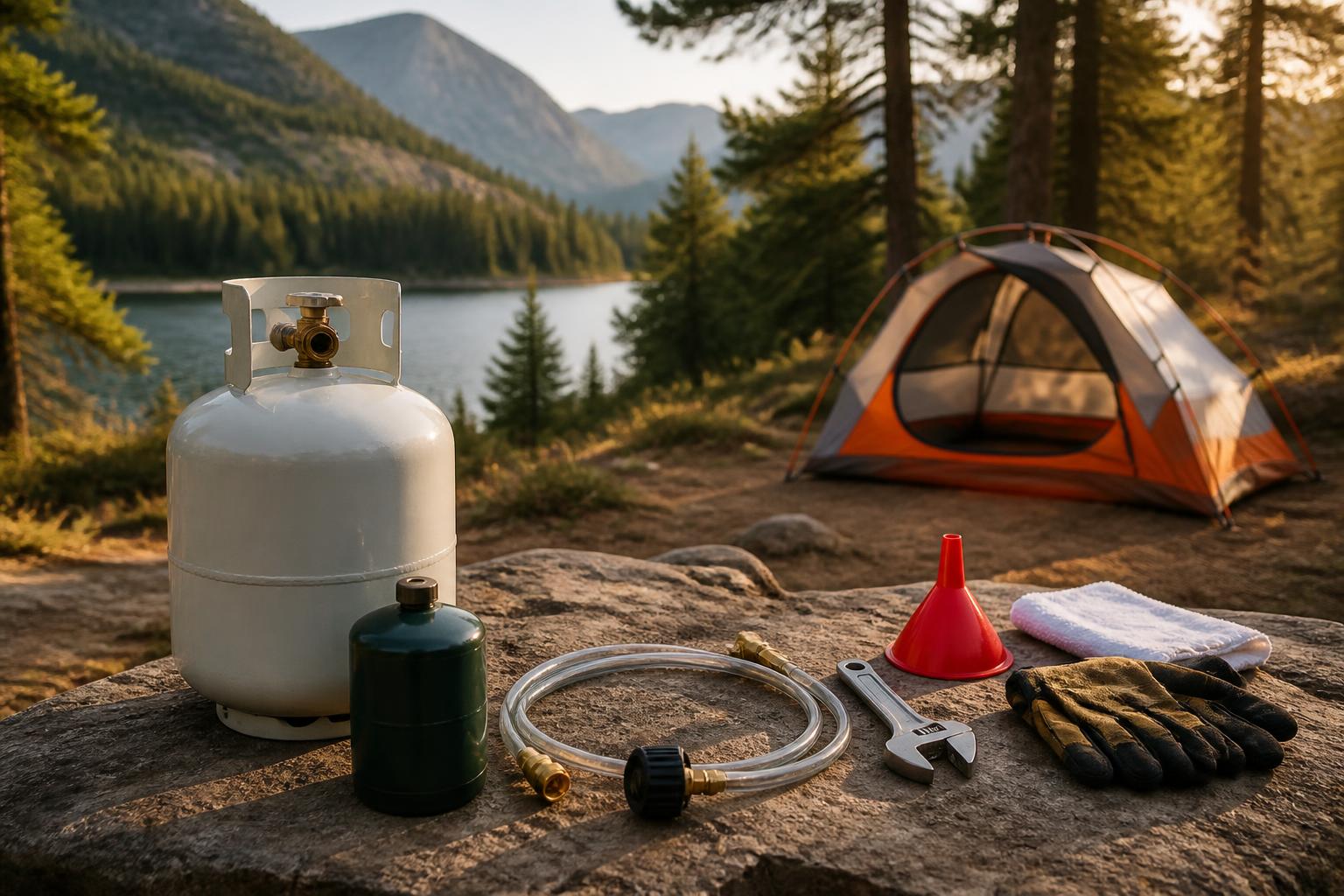
What You’ll Need – Check Each Item Before You Start
Missing even one piece of gear can turn a quick fill into a safety hazard. Confirm every line before you touch a valve.
- [ ] Refillable 1 lb cylinder – Must have a DOT stamp and a refillable valve. Look for brands like Flame King, Worthington, or Manchester. Not the green disposable kind.
- [ ] 20 lb propane tank – Must have an OPD (overfill prevention device) valve. Place the tank upright on a flat, stable surface outdoors.
- [ ] Propane transfer adapter – A rigid brass coupler with an integral shut-off valve that connects the 1 lb cylinder to the 20 lb tank. Commonly called a “1 lb to 20 lb adapter.”
- [ ] Scale – A kitchen or postal scale that reads in ounces, with a capacity up to 5 pounds.
- [ ] Leak-detection solution – A 50/50 mix of dish soap and water in a spray bottle, or a commercial leak-check fluid.

- [ ] Safety gear – Heavy-duty gloves and safety glasses. Work outdoors, far from any ignition source (no pilot lights, no open flames, no smoking).
Step-by-Step Refill Procedure
Work through these steps in order. Each checkpoint is there to catch problems early.
1. Weigh the Empty Cylinder and Record Its Tare Weight
Place the empty refillable 1 lb cylinder on the scale and write down the number. Most 1 lb refillables weigh between 1 lb 0 oz and 1 lb 4 oz when empty (the tare weight is stamped on the cylinder, often marked “TARE” followed by the weight in pounds and ounces).
Checkpoint: If the cylinder feels heavier than its tare weight by more than a couple of ounces, it still contains propane. Connect it to a stove or lantern and burn off the remaining gas outdoors before continuing. Never attempt to fill a partially full cylinder—you cannot gauge internal pressure safely, and overfilling becomes very likely.
2. Close Everything, Then Connect the Adapter
- Close the valve on the 20 lb tank (turn clockwise until fully seated).
- Close the adapter’s shut-off valve (clockwise).
- Screw the brass adapter onto the 20 lb tank’s Type 1 valve (hand-tight only—do not use a wrench).
- Attach the empty 1 lb cylinder to the other end of the adapter, again hand-tight.
Why hand-tight? Over-tightening can crack the brass threads or damage the O-ring. Finger-tight is enough to create a seal. If you need more leverage, use a rag to grip, but never a tool.
3. Open Valves in the Correct Order
- First, open the 20 lb tank’s valve slowly (turn counterclockwise). You will hear a short hiss as pressure equalizes.
- Second, open the adapter’s shut-off valve (counterclockwise). Propane will flow from the large tank into the small cylinder.
Listen for a steady hiss. If you hear a rapid, gurgling noise or nothing at all, close everything, check that both connections are snug (finger-tight), and try again. A constant moderate hiss is normal.
4. Fill by Weight – Never by Feel or Frost
Place the assembly on the scale or hold it over the scale every 15–20 seconds. The only reliable stop signal is weight. Ignore the cylinder feeling cold or frosting—those can appear well before it is full and are not a dependable indicator.
- Target full weight = tare weight + 1 lb (for a 1 lb cylinder). If your tare is 1 lb 2 oz, stop at 2 lb 2 oz.
- Overfilling is dangerous. Liquid propane expands with temperature, and an overfilled cylinder can rupture.
Stop threshold: As soon as the scale hits your target weight, close the adapter valve first (clockwise), then close the 20 lb tank valve. Do not let it run longer to “top off.”
5. Leak Test the Full Cylinder
Spray leak-detection solution around the valve stem and the sealing area where the cylinder meets the adapter. If bubbles appear, do not use the cylinder. Carefully open the valve outdoors (away from anything that could ignite) to release pressure, then inspect the cylinder’s O-ring and threads for damage. If everything looks clean and the bubbles are gone after retightening, test again. Still leaking? The cylinder or adapter is faulty—replace it.
6. Final Success Check
Your refilled cylinder is ready to use when:
- Weight is within 1–2 oz of your calculated target.
- No bubbles appear on the valve during leak test.
- Valve is fully closed and no propane smell is present.
- Cylinder is stored upright in a ventilated area away from heat or sparks.
If any of those conditions fail, do not use the cylinder. Vent it outdoors and escalate to a propane dealer for disposal or replacement.
Why Refillable Cylinders Are the Only Safe Option

Most people assume that a green disposable 1 lb cylinder can be refilled because it looks sturdy. In reality, the valve on a disposable cylinder is not designed for repeated use. The plastic or thin-metal valve can crack under pressure, and the cylinder itself lacks the hydrostatic testing required for refilling. A DOT-approved refillable cylinder has a thicker wall, a brass valve, and a stamped retest date. It is built to handle multiple pressurization cycles.
Counter-intuitive angle: You might think that frost forming on the cylinder means it is full. Actually, frost appears when liquid propane boils inside and cools the metal—this can happen at any fill level, especially in warm weather. The only accurate indicator is the weight on your scale. Relying on frost has led many people to overfill and create a dangerous condition.
Filling by Weight – The One Rule You Can’t Break
The most common mistake when refilling 1 lb cylinders is ignoring the scale. Propane expands and contracts with temperature, so a cylinder that feels “just right” by hand could be overfilled in hot weather. A 1 lb cylinder holds exactly 1 lb of propane by weight (about 16 fluid ounces by volume). Overfilling by even a couple of ounces can cause the internal pressure relief valve to open at the wrong time, or worse, cause a rupture.
Quick weight reference: A typical 1 lb refillable cylinder has a tare weight of 1 lb 2 oz. When full, it should weigh exactly 2 lb 2 oz. Write your specific tare weight on the cylinder with a permanent marker so you never have to guess.
When to Stop and Get Help
DIY refilling works great for decades—until something goes wrong. Stop immediately and seek professional help if:
- The cylinder shows visible rust, dents, or bulges.
- The valve feels stiff or won’t close completely.
- You smell gas after closing both valves and detaching the cylinder.
- The cylinder fails a leak test more than once after retightening.
In those cases, take the cylinder to a propane exchange station or a licensed gas supplier. Do not attempt to repair a valve or weld a cylinder—that’s a job for certified technicians.
Common Questions (FAQ)
Can I refill a standard green 1 lb cylinder?
No. Those cylinders are designed for single use only and their valves can fail under the pressure of refilling. Always use a DOT-approved refillable 1 lb cylinder.
How many times can I refill a refillable 1 lb cylinder?
Most are rated for up to 10 years from the manufacture date and can be refilled dozens of times as long as they pass a visual inspection and hydrostatic test (check the stamp for the retest date). Once expired, replace it.
Do I need a special adapter or can I use a hose?
You need a rigid brass transfer adapter with an integral shut-off valve. Hoses are not recommended—they can kink, causing uncontrolled flow or a leak.
What if the 20 lb tank is cold?
Cold propane flows slowly. Place the large tank in a warm (not hot) water bath or let it sit in direct sunlight for 30 minutes. Never use an open flame, heat gun, or electric heater to warm it.

Camping Bob has spent over 20 years camping across the US — from BLM dispersed sites in the Southwest to KOA campgrounds in the Pacific Northwest. He writes practical, no-nonsense guides to help fellow campers get outdoors with confidence.