
How To Determine The Size Of Your Propane Tank
Quick answer
- Look for stamped numbers and letters on the tank’s collar or data plate.
- Tank sizes are typically measured in pounds (lbs) of propane capacity.
- Common sizes include 5lb, 10lb, 20lb (grill tanks), 30lb, and 40lb.
- The “water capacity” in gallons can also be a clue, but lbs is standard for exchange/refill.
- For smaller, disposable tanks, look for weight markings or product descriptions.
- If all else fails, weigh it (empty) and estimate based on common tank weights.
For common uses like grilling, a 20lb propane tank is usually the standard. Consider this reliable 20 lb propane tank for your outdoor cooking needs.

What to check first (do this before you drive out)
Before you even think about hooking up your propane tank for a trip, there are a few key things to check. Don’t be that person who gets to the campsite and realizes their tank is empty or the wrong size.
- Land manager / legality: Who actually owns and manages the land you’re on? Is it a National Forest, BLM land, State Park, or private campground? Different places have different rules, especially regarding fires and approved equipment. Always check the official website or call ahead. A quick Google search for “[Location Name] camping rules” usually gets you close.
- Access/road conditions: How are you getting to your spot? Is it a paved road, a bumpy dirt track, or something requiring serious 4×4? Know your vehicle’s capabilities and ground clearance. A sedan might be fine for a campground, but a lifted Jeep is often needed for dispersed camping. Don’t get stuck miles from anywhere.
- Fire restrictions + weather + wind: This is huge. Fire bans can happen suddenly. Check the local fire danger levels and any active burn bans. Also, look at the weather forecast – rain can be a bummer, but high winds can make campfires or even grills dangerous. Always have a backup cooking plan if fires are out.
- Water plan + waste plan (Leave No Trace): Where are you getting your water? Are you bringing it all? Is there potable water available? And what about waste? Pack it in, pack it out. Know your plan for grey water and trash disposal. Leave your spot cleaner than you found it. That’s just good camping karma.
- Safety (wildlife, distance to help, comms): What kind of critters are in the area? Bears? Raccoons? Store your food properly. How far is the nearest ranger station or town? Do you have cell service? Consider a satellite communicator for remote trips. Better safe than sorry out there.
Step-by-step (field workflow)
So, you’ve got a propane appliance, maybe a stove or a heater, and you need to figure out what size tank you’ve got or what you need. It’s not rocket science, but it pays to be methodical.
1. Locate the tank’s collar: This is the metal ring around the top of the tank, usually where the handle is attached. It’s the most common spot for crucial information.
- Good looks like: Clear, stamped numbers and letters that are easy to read.
- Common mistake: Ignoring the collar because it looks beat up. Sometimes the info is just dirty. Give it a quick wipe.
2. Identify the “DOT” or “TC” stamping: Look for markings like “DOT 4BW 240” or “TC 5962”. These indicate the tank meets Department of Transportation (US) or Transport Canada standards. The numbers following often relate to pressure ratings.
- Good looks like: Seeing these standard markings confirms it’s a legitimate propane cylinder.
- Common mistake: Freaking out about all the numbers. Focus on the ones that indicate size or capacity.
3. Find the “Water Capacity” (WC): This is often stamped near the DOT/TC info. It will be in gallons, like “WC 47.0 LBS” or “WC 19.2 GAL”. This tells you how much water the tank could hold.
- Good looks like: A clear gallon number.
- Common mistake: Confusing water capacity with propane capacity. They aren’t the same thing, but they’re related.
4. Look for the “Tare Weight” (TW): This is the weight of the empty tank. It’s usually stamped as “TW 18.5 LBS”. This is super helpful if you’re trying to figure out how much propane is left, or if you need to estimate the tank’s size.
- Good looks like: A clear weight marking, usually in pounds.
- Common mistake: Thinking the TW is the full weight. It’s just the empty weight.
5. Find the “Nominal Capacity” (NC) or “Rated Capacity”: This is the most important one for telling the size of your propane tank. It’s usually stamped clearly and will be in pounds (lbs), like “NC 20 LB” or “42.4 LB”. This is the amount of propane the tank is designed to hold.
- Good looks like: A number followed by “LB” or “LBS”. This is your tank size.
- Common mistake: Not finding this specific marking and getting stuck with just the water capacity. Keep looking!
6. Check the data plate (if present): Some larger or older tanks might have a separate metal plate riveted on, with more detailed specifications.
- Good looks like: A plate with legible text and numbers.
- Common mistake: Overlooking a separate data plate. It’s not always on the collar.
7. Consider common tank sizes: Most standard BBQ grill tanks are 20 lbs. Smaller camping tanks are often 5 lbs or 10 lbs. Larger RV tanks can be 30 lbs or 40 lbs. If you see a number that seems reasonable for its size, it’s probably correct.
- Good looks like: Your tank looks like a standard 20lb tank and the stamping says “20 LB”.
- Common mistake: Assuming a tank is a certain size just by its look without checking the markings. They can be deceiving.
8. If no markings are visible, weigh it: If the tank is completely stripped of markings (rare, but possible), you can weigh it when empty. A standard 20lb tank (full) weighs around 35-38 lbs. The empty weight (TW) is usually around 15-18 lbs.
- Good looks like: You use a reliable scale and get a consistent reading.
- Common mistake: Using a cheap bathroom scale that’s not accurate, or weighing a tank that still has fuel in it.
Common mistakes (and what happens if you ignore them)
| Mistake | What it causes | Fix |
|---|---|---|
| Ignoring the collar markings | Not knowing your tank size, leading to incorrect refills or appliance use. | Always wipe down and inspect the collar for stamped numbers and letters. |
| Confusing water capacity (WC) with propane capacity (lbs) | Buying the wrong size tank or getting the wrong amount of propane. | Look specifically for “NC” (Nominal Capacity) or a number followed by “LB” or “LBS”. |
| Assuming tank size by appearance | Using an undersized tank for a high-demand appliance, or overfilling a small one. | Always verify with the stamped markings. Appearance can be misleading. |
| Not checking the Tare Weight (TW) | Difficulty in estimating remaining fuel or knowing when a tank is truly empty. | Locate and note the TW. It’s essential for tracking fuel levels accurately. |
| Using a damaged or uncertified tank | Leaks, potential explosions, or being denied refills/exchanges. | Visually inspect the tank for rust, dents, or valve damage. Check for valid DOT/TC markings. |
| Not knowing the propane density | Miscalculating how much propane you have based on weight. | Understand that propane is sold by weight (lbs) for a reason; it’s the standard measure. |
| Trying to refill a disposable tank | Dangerous and illegal. These are designed for single use. | Purchase refillable tanks. Never attempt to refill disposable canisters. |
| Not having a backup plan for fuel | Running out of propane mid-meal or mid-heat during a trip. | Always carry a spare, correctly sized tank, or know where you can refill/exchange. |
| Overfilling a tank (if you refill yourself) | Dangerous pressure buildup, potential rupture. | Adhere strictly to refill station procedures or professional guidance. Never fill past 80%. |
| Using a tank not rated for the appliance | Appliance may not function correctly or safely. | Ensure your tank’s capacity and pressure rating match your appliance’s requirements. |
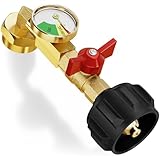
If you’re looking to refill smaller cylinders from a larger tank, a propane refill adapter can be a handy tool. Ensure you use it safely and according to instructions.
Decision rules (simple if/then)
- If you see “NC 20 LB” stamped on the collar, then your tank is a standard 20-pound propane tank because “NC” stands for Nominal Capacity and “LB” means pounds.
- If the tank only shows a gallon water capacity (e.g., “WC 47.0 LBS”), then you need to look for a separate “Nominal Capacity” or a weight marking in pounds to know its propane size.
- If the tare weight (TW) is around 15-18 lbs, then it’s likely a 20lb propane capacity tank, assuming it’s in good condition.
- If you’re using a small camping stove that uses small canisters, then you’re probably not dealing with a large pound-rated tank, but rather disposable 1lb propane cylinders.
- If you need to power a large RV appliance, then you’ll likely need a 30lb or 40lb tank, as smaller tanks won’t have enough capacity.
- If you find a tank with a “TC” marking instead of “DOT,” then it’s a Canadian-certified tank, which is generally interchangeable in the US but good to note.
- If the tank appears heavily rusted or has significant dents, then it’s probably not safe to use and should be retired.
- If you plan to exchange your tank, then you only need to know it’s a standard size (like 20lb); they don’t typically refill by weight on the spot.
- If you’re unsure about any markings or the tank’s condition, then it’s best to err on the side of caution and consult a propane dealer or tank exchange service.
- If your appliance’s manual specifies a minimum tank size, then you must use a tank that meets or exceeds that requirement.
- If you are refilling the tank yourself and it doesn’t have a clear “NC” marking, then find the water capacity and roughly estimate the propane capacity (often around 40-45% of water capacity by volume, but weight is standard).
If you’re looking for a versatile tank for grilling or camping, a 20 lb propane tank is a popular and practical choice. It’s widely compatible with many outdoor appliances.
FAQ
How do I know if my propane tank is empty?
Most portable propane tanks have a gauge on the regulator, or you can use a propane tank gauge tool. Another common method is to weigh the tank; if it’s close to its marked Tare Weight (TW), it’s nearly empty.
Can I use a smaller propane tank than recommended?
It depends on the appliance. Small camping stoves are fine with 1lb canisters. Larger appliances like grills or heaters might run poorly or not at all on a tank too small for their BTU needs. Always check appliance specs.
What’s the difference between a 20lb and a 20lb water capacity tank?
A “20lb tank” refers to its propane capacity in pounds (lbs). A “20lb water capacity” tank would hold about 20 lbs of water, which translates to a much smaller propane capacity, typically around 8-10 lbs. Always look for the “LB” or “LBS” marking for propane size.
Are all propane tanks refillable?
No. Disposable 1lb cylinders are not refillable and should be recycled properly. Larger tanks with DOT or TC markings are designed for refilling or exchange.
Where can I get my propane tank refilled or exchanged?
Many hardware stores, grocery stores, gas stations, and dedicated propane dealers offer exchange services. For direct refills, look for licensed propane dealers.
How often should I replace my propane tank?
Propane tanks don’t have a strict expiration date like some other containers, but they do need periodic inspection. Check for rust, dents, or valve damage. Many dealers will refuse to fill or exchange tanks that are too old or in poor condition.
What does “WC” mean on a propane tank?
WC stands for Water Capacity. It’s the volume of water the tank could hold, measured in gallons or liters. It’s a factor in determining the propane capacity but isn’t the direct propane size.
Is it safe to transport a propane tank in my car?
Yes, but it must be transported upright, secured, and in a well-ventilated area. Never transport a tank inside a closed vehicle’s passenger compartment. Transport it in the trunk or truck bed, with windows open if possible.
What this page does NOT cover (and where to go next)
- Detailed instructions on how to refill a propane tank yourself (this requires specialized knowledge and equipment).
- Specific BTU ratings for various propane appliances and how they relate to tank size (check your appliance manual).
- The chemical properties of propane or its safe storage in extreme temperatures.
- The process for certifying or re-certifying older propane tanks for continued use.
- Troubleshooting common propane appliance issues (like regulators freezing or burners not igniting).

Camping Bob has spent over 20 years camping across the US — from BLM dispersed sites in the Southwest to KOA campgrounds in the Pacific Northwest. He writes practical, no-nonsense guides to help fellow campers get outdoors with confidence.