
How Long Does a Propane Cylinder Last?
Quick answer
- A small 1lb propane cylinder can last anywhere from 1.5 to 10 hours, depending on your stove and usage.
- Higher BTU appliances burn through fuel faster.
- Consistent flame settings use fuel more predictably than variable ones.
- Consider a larger refillable tank for longer trips to save money and waste.
- Always carry a spare cylinder or two, just in case.
- Check your cylinder for damage before each use.
For convenient and portable fuel, consider stocking up on these reliable 1 lb propane cylinders for your next trip.

What to check first (do this before you drive out)
Before you even think about packing the car, get your fuel situation sorted. It’s a bummer to run out of propane halfway through boiling water for coffee.
- Appliance BTU Rating: Know your stove’s power. This is usually listed in BTUs (British Thermal Units) per hour. Higher BTU means it’s more powerful but also burns through propane faster. A small backpacking stove might be 7,000 BTU, while a two-burner camp stove could be 20,000 BTU per burner.
- Your Trip Length & Needs: How many meals are you cooking? How often will you need hot water? A weekend car camping trip with a couple of people boiling water and cooking simple meals will use less fuel than a week-long expedition with elaborate camp cuisine.
- Propane Cylinder Size: The most common disposable cylinders are 1lb (16.4 oz). Larger refillable tanks are available, often 5lb, 10lb, or 20lb. These are heavier but much more economical for extended use.
- Stove Type & Usage Habits: Are you just heating water, or are you simmering a stew for an hour? Do you run your stove on high all the time, or do you keep it at a low simmer? These usage patterns drastically affect how long a cylinder lasts.
For longer trips or car camping, a 20 lb propane tank offers a more economical and sustainable fuel solution.

Step-by-step (field workflow)
This is how you figure out how long your propane cylinder will last once you’re out there. It’s not rocket science, but it pays to be methodical.
1. Identify your stove’s BTU rating.
- What to do: Look for a sticker or plate on your stove. It might say something like “20,000 BTU/hr” or similar.
- What “good” looks like: You have a clear number for your stove’s maximum output.
- Common mistake: Not knowing your stove’s rating. You’re guessing at fuel consumption. Fix: Find the sticker or check the manufacturer’s website.
2. Calculate estimated burn time per cylinder.
- What to do: A standard 1lb propane cylinder holds about 16.4 oz of propane. Divide the total ounces of propane in the cylinder by your stove’s BTU rating, then multiply by 91,500 (BTUs per pound of propane). This gives you a theoretical burn time. (16.4 oz / Stove BTU) \* 91,500 = Total Burn Time in hours.
- What “good” looks like: You have a rough number, like “This stove should burn for about 3 hours on high with a 1lb cylinder.”
- Common mistake: Doing no math at all. You just hope for the best. Fix: Do the quick calculation. It’s a good baseline.
3. Factor in your typical usage.
- What to do: If your stove is rated at 20,000 BTU/hr, and you typically run it at half power (10,000 BTU/hr), your burn time will double. If you only use it for 15 minutes at a time to boil water, that’s different than simmering for an hour.
- What “good” looks like: You’re thinking realistically about how you actually use the stove, not just its max output.
- Common mistake: Assuming you’ll always run the stove on high. Fix: Be honest about your cooking habits.
4. Test run your stove.
- What to do: Before your trip, set up your stove and run it for a set amount of time (e.g., 30 minutes) on your usual setting. Note how much fuel you used.
- What “good” looks like: You have real-world data for your specific setup.
- Common mistake: Never testing the stove at home. Fix: A quick test run at home saves surprises in the field.
5. Pack enough fuel.
- What to do: Based on your estimated burn time, trip length, and usage, pack an extra cylinder or two. It’s better to have too much than too little.
- What “good” looks like: You have a comfortable buffer of fuel.
- Common mistake: Packing just enough, or slightly too little. Fix: Always pack a spare. Trust me on this.
6. Monitor fuel levels during use.
- What to do: Pay attention to the flame. If it starts to sputter or the heat diminishes significantly, you’re running low.
- What “good” looks like: You’re aware of your fuel status and can switch to a spare before you’re completely out.
- Common mistake: Ignoring warning signs and running the cylinder completely dry. Fix: Listen to your stove.
7. Store cylinders properly.
- What to do: Keep them upright, in a cool, dry, well-ventilated area away from heat sources.
- What “good” looks like: Cylinders are stored safely and are ready for use.
- Common mistake: Leaving them in a hot car or near a campfire. Fix: Proper storage is key for safety and longevity.
8. Consider refillable tanks for longer trips.
- What to do: If you camp often or for extended periods, investing in a larger refillable tank (like a 5lb or 20lb) and a hose adapter for your stove can save significant money and reduce waste.
- What “good” looks like: You’re using a more sustainable and cost-effective fuel solution.
- Common mistake: Sticking with disposable 1lb cylinders for every trip, regardless of duration. Fix: Evaluate your camping frequency and switch to refillable if it makes sense.
Common mistakes (and what happens if you ignore them)
| Mistake | What it causes | Fix |
|---|---|---|
| Not knowing your stove’s BTU rating. | You have no idea how much fuel you’ll use. You might pack too little, leaving you cold, or too much, carrying unnecessary weight. | Find the BTU rating on your stove. It’s usually a sticker or stamped into the metal. If you can’t find it, check the manufacturer’s website or estimate conservatively. |
| Assuming max burn time is your actual burn time. | You’ll run out of fuel much faster than you expect because you’re not accounting for how you actually use the stove (e.g., simmering vs. boiling, lower heat settings). | Be realistic about your cooking habits. If you usually run your stove on medium heat, calculate based on that, not the maximum BTU. A good rule of thumb is to assume you’ll use about half the maximum BTU for average cooking. |
| Packing only the calculated amount of fuel. | You might get caught short if your cooking takes longer than expected, if a cylinder is faulty, or if you need to cook more meals than planned. Running out of fuel when you need it is a real drag. | Always pack at least one extra 1lb cylinder for short trips, or significantly more for longer ones. For car camping, a larger refillable tank is a much better option. |
| Not testing your stove at home. | You might discover a leak, a faulty regulator, or a burner that doesn’t work properly only when you’re miles from anywhere. This can ruin a trip or, worse, be a safety hazard. | Before any trip, set up your stove and run it for a bit. Check for leaks with soapy water (bubbles indicate a leak). Ensure the flame is consistent and the regulator is working. |
| Leaving propane cylinders in direct sun. | Propane expands when heated. This can increase pressure inside the cylinder, potentially leading to a leak or, in extreme cases, rupture. It also makes the fuel less efficient. | Store cylinders in a cool, shaded place. If you must leave them in your vehicle, ensure the vehicle is parked in the shade and that the windows are cracked for ventilation. Never store them near a heat source like a campfire or stove. |
| Using a damaged cylinder. | A dented or corroded cylinder is a serious safety hazard. It could leak or fail under pressure, leading to a fire or explosion. | Visually inspect every cylinder before attaching it to your stove. If you see any significant dents, rust, corrosion, or damage to the valve, do not use it. Dispose of it properly and get a new one. |
| Not accounting for altitude or cold weather. | In cold temperatures, propane’s vaporization rate decreases, meaning your stove might not perform as well or might run out of fuel faster than expected. High altitudes can also affect burn efficiency. | If camping in cold weather, try to keep cylinders insulated or warmer (but not hot!). Consider using a larger tank, as they tend to perform better in cooler conditions. For high altitudes, be aware that your stove might burn slightly differently. |
| Over-tightening the connection. | While you want a secure connection, over-tightening can damage the threads on the cylinder or the stove’s regulator, leading to leaks or making it difficult to attach/detach cylinders in the future. | Hand-tighten the connection until it’s snug. You don’t need a wrench. If you feel significant resistance, stop. A good seal is all you need. |
| Not having a backup plan for fuel. | This is the ultimate mistake. You run out of propane, and you have no way to cook, boil water, or stay warm if your stove is your primary heat source. This can range from an inconvenience to a genuine safety issue. | Always have a spare cylinder. For longer trips, consider a larger refillable tank. Know where the nearest place is to buy more fuel if you’re in a pinch. |
Decision rules (simple if/then)
- If your trip is longer than a weekend, then consider a refillable propane tank because 1lb cylinders become expensive and wasteful.
- If you are cooking complex meals that require simmering for extended periods, then assume your propane will last half as long as the theoretical maximum burn time because simmering uses more fuel than boiling.
- If you are camping in temperatures below freezing, then keep your propane cylinders as warm as possible (without direct heat) because cold reduces propane vaporization.
- If your stove has a high BTU rating (e.g., over 15,000 BTU/hr), then you will burn through 1lb cylinders much faster than a low-BTU backpacking stove because more BTUs mean more fuel consumed per hour.
- If you are car camping and have the space, then pack an extra 1lb cylinder (or two) because running out of fuel is a miserable experience.
- If you see any dents, rust, or damage on a propane cylinder, then do not use it because it is a safety hazard.
- If you are only heating water for coffee and tea, then you can likely get away with fewer cylinders than if you are cooking full meals.
- If you are using a multi-burner stove, then assume you’ll use fuel at roughly double the rate of a single-burner stove, all else being equal, because you have two heat sources.
- If you are unsure about fuel consumption, then do a test run at home for 30 minutes on your typical setting to get a real-world estimate.
- If you are planning a long backpacking trip where weight is critical, then you’ll need to meticulously calculate your fuel needs and potentially use a more fuel-efficient stove.
- If you are renting a camp stove, then check what type of fuel connection it uses and buy the appropriate cylinders.
FAQ
How many hours will a 1lb propane cylinder last on a typical camp stove?
This varies a lot, but for a common two-burner camp stove running on medium, expect around 1 to 2 hours per cylinder. Simpler backpacking stoves might get 3 to 4 hours.
Does altitude affect how long propane lasts?
Yes, indirectly. While the amount of propane in the cylinder doesn’t change, the rate at which it vaporizes and burns can be affected by lower atmospheric pressure at higher altitudes, and especially by colder temperatures that often accompany altitude.
How can I tell if my propane cylinder is almost empty?
The flame will start to sputter, become weaker, or turn yellow. You’ll notice a significant drop in heat output.
Is it safe to refill 1lb propane cylinders?
No, it is generally not recommended or safe to refill disposable 1lb propane cylinders. They are designed for single use. Refilling them can be dangerous if not done with specialized equipment and knowledge.
What’s the difference between propane and butane for camping stoves?
Propane is better for colder temperatures because it vaporizes at much lower temps than butane. Butane is lighter and works well in warmer weather. Many stoves can use either, but check your manual.
How much propane is in a 1lb cylinder?
Technically, it’s about 16.4 ounces (or 1 pound) of propane by weight.
Can I use a larger propane tank with my small camp stove?
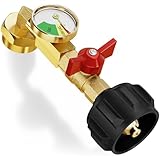
Yes, you can, but you’ll need an adapter hose designed to connect a larger tank (like a 20lb BBQ tank) to your stove’s regulator. This is a great option for car camping.
To connect a larger tank to your small camp stove, you’ll need a quality propane tank adapter for seamless operation.
How should I store unused propane cylinders?
Store them upright in a cool, dry, well-ventilated area, away from any heat sources, flames, or direct sunlight.
What this page does NOT cover (and where to go next)
- Specific BTU ratings for every single camp stove model. (Check your stove’s manual or manufacturer website).
- Detailed instructions on how to refill propane tanks (this is a specialized task and can be dangerous).
- Information on other types of camping fuel like white gas, liquid fuel, or isobutane canisters.
- Troubleshooting specific stove malfunctions beyond fuel issues.
- The exact legal regulations for transporting propane tanks in vehicles.
- In-depth comparisons of different camp stove brands and models.

Camping Bob has spent over 20 years camping across the US — from BLM dispersed sites in the Southwest to KOA campgrounds in the Pacific Northwest. He writes practical, no-nonsense guides to help fellow campers get outdoors with confidence.